
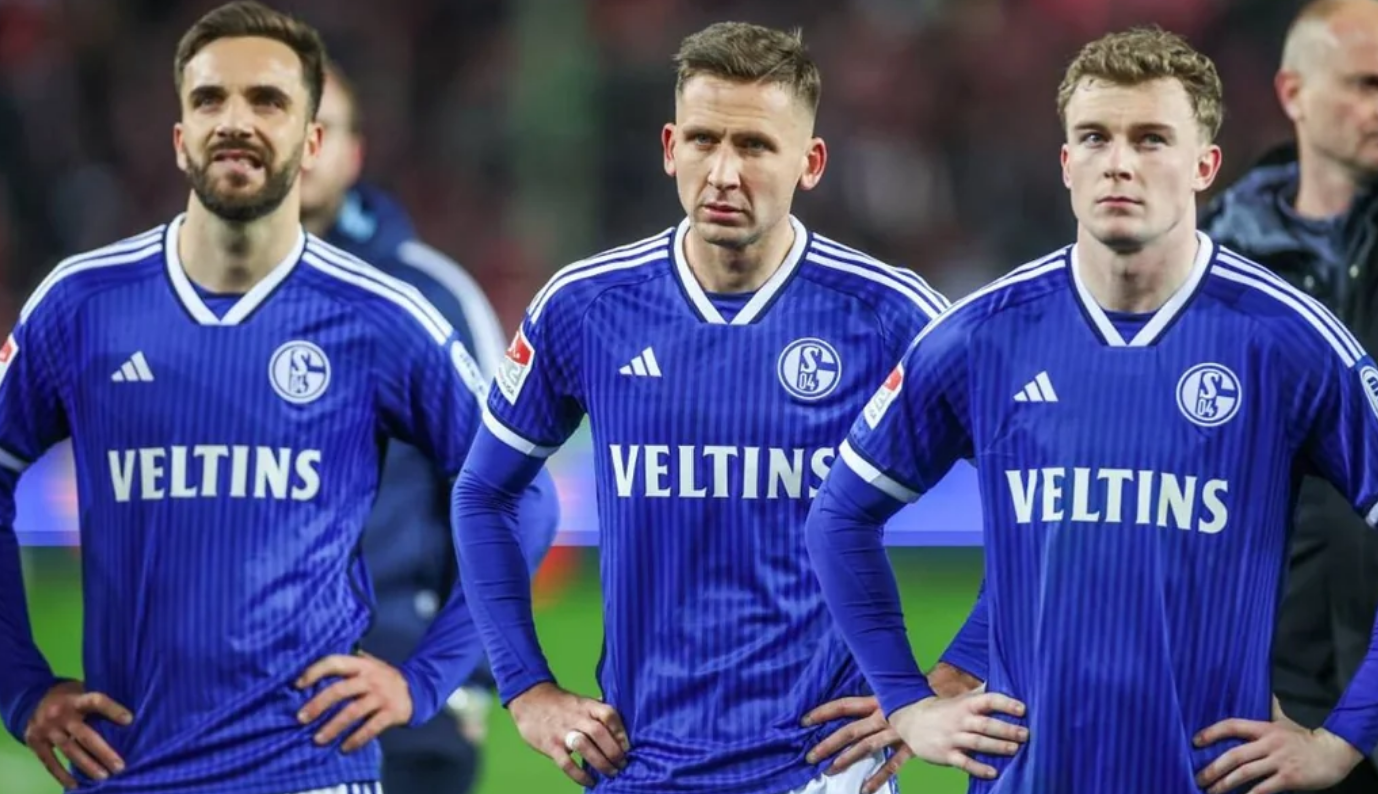
The Royal Blues, broken by mismanagement
Schalke 04 should never feel small. Everything about the club suggests scale: the packed Veltins-Arena, the Royal Blue shirts, the mining identity, the noise, the history and the almost painful loyalty of its supporters. Schalke are not just a football team from Gelsenkirchen.
They are part of the city’s emotional infrastructure.
That is why the fall was so dramatic. Schalke did not simply have a bad season. They became a warning.
For much of the modern Bundesliga era, Schalke were major players. They competed in Europe, reached the Champions League semi-finals in 2011, won domestic cups and produced or developed elite talents. Manuel Neuer, Mesut Özil, Julian Draxler, Leroy Sané, Leon Goretzka and Joël Matip all passed through the club. The raw ingredients were huge: academy, stadium, fanbase, history and identity.
But size can hide weakness.
Schalke’s decline was not caused by a single relegation. It was years in the making.
The club carried the expectations of a Champions League organisation while the football operation became increasingly unstable. Recruitment missed too often. Coaches changed too frequently. The squad became expensive and unbalanced. Valuable players left without the club consistently turning their talent into lasting sporting strength.
The 2017/18 season now looks like a false summit. Schalke finished second in the Bundesliga under Domenico Tedesco, but the football was more functional than foundational. Instead of becoming the start of a new era, it became the last clear memory before the slide. The structure underneath was already creaking.
Then came the collapse. Schalke were relegated from the Bundesliga in 2021 for the first time in 33 years. The Guardian reported that angry supporters confronted players and staff after the decisive defeat to Arminia Bielefeld, while Schalke said some individuals had “clearly stepped over lines that are non-negotiable.”
That moment showed the emotional violence of the fall. Supporters who had followed Schalke through everything watched a giant lose its place in the top flight. Relegation was not just a sporting failure. It felt like a civic wound.
Financial pressure made everything worse. Schalke’s own financial reports show the depth of the repair job. In March 2025, the club said it had improved its consolidated equity position to -€98.1 million, from -€103.3 million the previous year. In October 2025, Schalke reported a consolidated net profit of €5.5 million for the 2024/25 financial year, presenting it as part of a continuing financial recovery.
Those figures matter because debt changes how a football club behaves. It narrows options. It forces caution. It means every transfer mistake carries greater consequence. Schalke were no longer simply trying to build a competitive squad; they were trying to repair the balance sheet while carrying the expectations of a club that still sees itself as Bundesliga-sized.
CFO Christina Rühl-Hamers captured the scale of the recovery when she described the club’s financial repair as
“a marathon and not a sprint.”
That line belongs in the heart of the Schalke story. Promotion alone does not fix a club. It changes the league table, but the deeper work remains.
Schalke briefly returned to the Bundesliga after their first relegation, only to go down again in 2023. That second fall was damaging because it proved the problem had not been solved. A true recovery requires more than emotion, more than a full stadium and more than one strong campaign. It requires a functioning football department.
The recovery has finally begun to look more credible. Schalke’s 2026 financial update showed another positive half-year result, though liabilities remained part of the picture. Reports in 2026 also described a club trying to reconnect with its identity and fight its way back through structure, discipline and community energy.
The lesson of Schalke is stark: a huge fanbase can sustain a club emotionally, but it cannot compensate forever for poor decision-making. Love fills the stadium. It does not balance recruitment, protect contracts, control wages or build a coherent playing style.
The route back must be sober. Schalke need to avoid behaving like the old Schalke too soon. They need controlled wages, smarter recruitment, academy pathways, managerial patience and a football identity that matches the club’s working-class intensity without becoming chaos.
Schalke’s greatest asset remains its people. Few clubs can generate that kind of loyalty after so much pain. But loyalty should not be exploited as a substitute for competence.
The Royal Blues fell because their structure could not carry the size of their identity. Their future depends on making the football club as strong as the support that never left it.
Suggested Sources
- Schalke 04 official website — For the club’s 2024/25 financial report, including its net profit and ongoing financial recovery.
- Schalke 04 official website — For the half-year 2024/25 financial update, including the improvement in consolidated equity capital from -€103.3m to -€98.1m.
- The Guardian / Reuters — For Schalke’s 2021 relegation, the supporter confrontation afterwards, and the quote that some individuals had “clearly stepped over lines that are non-negotiable.”
- Bundesliga official website — For Schalke’s 2026 promotion back to the Bundesliga and wider context on the club’s return.
- SuperSport / AFP — For a strong summary of Schalke’s fall and recovery, including the 2021 relegation, debt pressure, immediate return, second relegation and eventual comeback.


Leave a Reply