
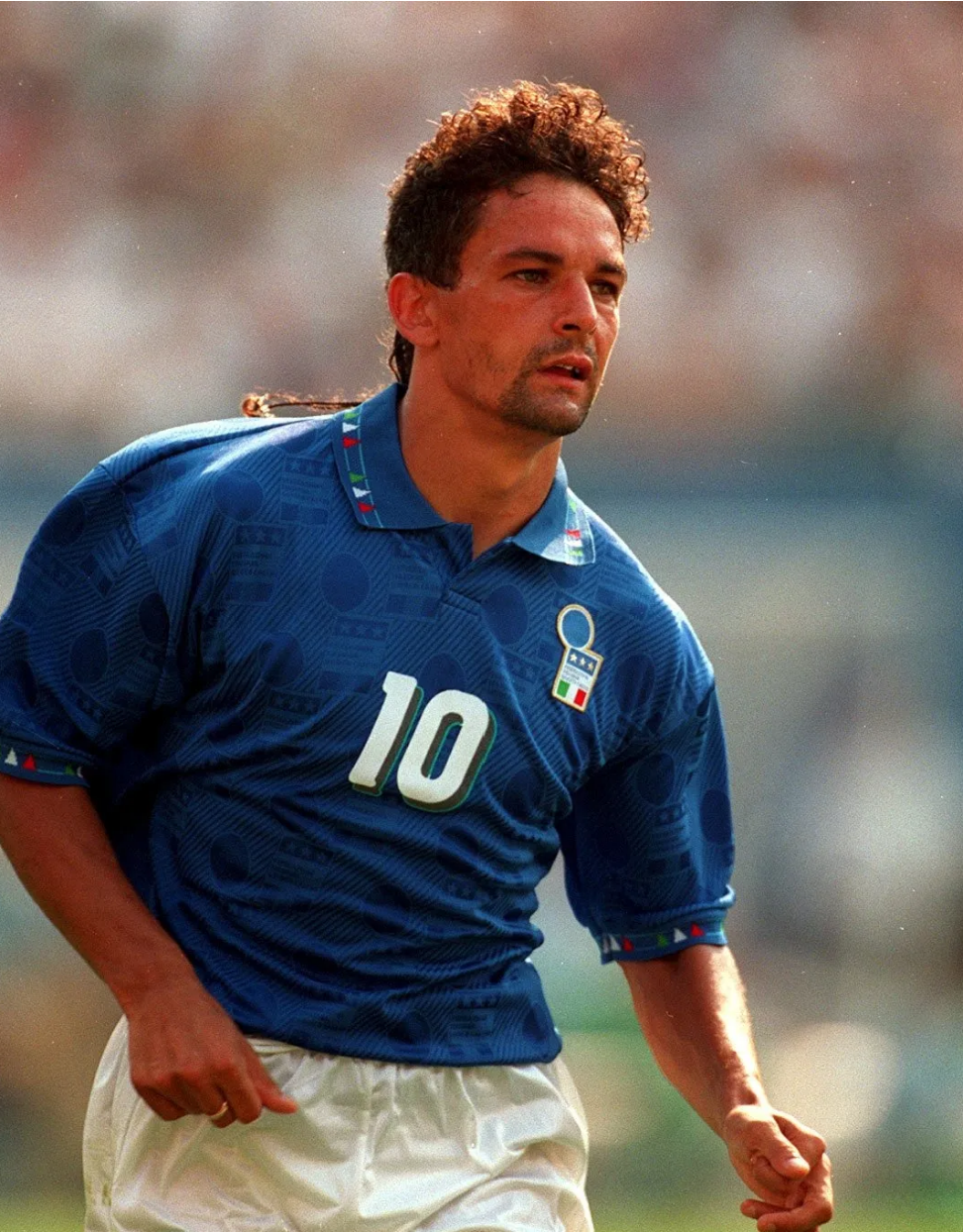
Roberto Baggio never looked like a footballer designed for noise. He moved with a strange quietness, head slightly bowed, ponytail bouncing behind him, as if he was carrying something heavier than a shirt number. Then the ball arrived, and everything changed.
There was grace in the way Baggio played, but also tension. Every touch seemed delicate, yet every match felt emotionally charged. He was not simply a fantasista, a second striker, or a No. 10. He was the kind of player who made football feel personal. Supporters did not just admire him; they seemed to suffer with him.
His story is impossible to separate from beauty, injury, resilience and heartbreak. The dribbles, free-kicks and finishes made him one of Italy’s greatest ever players. The missed penalty in the 1994 World Cup final made him immortal in a different, crueller way. That is the strange power of Baggio’s legacy: he is remembered not only for what he won, but for what he made people feel.
Playing Style
Baggio was a classic Italian fantasista, operating between midfield and attack, drifting into pockets where defenders were unsure whether to follow or hold shape. He could play as a second striker, attacking midfielder or advanced creator, but his best work came when he was given freedom rather than strict tactical instructions.
Technically, he was close to flawless. His first touch softened difficult passes. His balance allowed him to glide away from pressure. His right foot could disguise passes, bend free-kicks, clip finishes and open shooting angles from almost nothing. He was not physically dominant, but he had the rare ability to make opponents commit before he had fully revealed his idea.
What made Baggio different was his emotional rhythm. He was not a relentless runner or a system player. He played in moments: a sudden slalom, a reverse pass, a curved finish into the far corner. Coaches sometimes struggled to fit him into rigid structures, but supporters understood him immediately. He gave matches a sense of possibility.
Rise to Fame
Baggio’s early career was shaped by promise and pain. At Vicenza, he was already being spoken about as one of the brightest young talents in Italian football. He had the balance, imagination and technical quality that immediately separated him from ordinary prospects. But before his career had properly opened, he suffered a devastating knee injury in 1985, tearing multiple ligaments and requiring major surgery.
For a lesser talent, or a less stubborn personality, that could have been the story before the story. Fiorentina had already agreed to sign him, and despite the severity of the injury, the club went through with the deal. It was a huge act of faith, and it became one of the defining decisions in Baggio’s career.
His early years in Florence were not straightforward. He had to rebuild his body while carrying the expectations of a fanbase desperate for a new idol. But once he found rhythm, Baggio became the emotional centre of Fiorentina. He was not just another talented attacker. He was the player who gave supporters a reason to believe their club had someone truly special.
Florence took to him because he played with beauty, but also because he seemed vulnerable. There was a fragility to Baggio that made his brilliance feel even more precious. He was capable of drifting through defenders with almost impossible grace, then being hacked down by opponents who had no other way to stop him. His relationship with Fiorentina supporters became deeply personal, which is why his move to Juventus in 1990 caused such fury.
The transfer was not treated like normal business. It felt like a betrayal, even though Baggio himself was not the driving force behind it. Fiorentina fans rioted in protest, and when he later returned to Florence with Juventus, the tension was obvious. In one famous moment, after refusing to take a penalty against Fiorentina, Baggio picked up a Viola scarf thrown from the crowd as he left the pitch. It was a small gesture, but it said a lot about his emotional connection to the club he had left behind.
At Juventus, the challenge changed. Baggio was no longer only a beloved local genius; he had to become the leading man for one of Italy’s biggest clubs. He was joining a team and a city with different expectations, where beauty alone would not be enough. He had to deliver trophies, goals and decisive performances under a much harsher spotlight.
Gradually, he did exactly that. The Juventus version of Baggio was more complete, more ruthless and more recognised across Europe. He became the reference point of the attack, the player who could carry the ball from deep, create for others, score from free-kicks and decide matches with moments of individual invention.
By the early 1990s, Baggio was no longer just a wonderful Italian talent. He was one of the best players in the world.
Peak Period
Baggio’s peak came during the early-to-mid 1990s, when his individual brilliance reached its highest level and his reputation became global. At Juventus, he was the kind of player opponents could prepare for and still fail to contain. He was not explosive in the same way as some great attackers, but he had control, deception and an extraordinary sense of timing.
The 1992/93 season was one of the clearest examples of his greatness. Juventus won the UEFA Cup, with Baggio central to their European campaign. He scored decisive goals, carried the creative burden and gave the team a player who could turn tight knockout matches through individual quality. That season helped push him towards the highest individual recognition in the game.
In 1993, Baggio won the Ballon d’Or and was named FIFA World Player of the Year. It was not a sentimental award. It was recognition that, at that moment, he was operating at a level few players could match. Italian football in that era was stacked with elite defenders, elite coaches and tactically disciplined teams. For a creative forward to dominate in that environment said everything about his quality.
Baggio’s Juventus peak was not built on one narrow skill. He could play as a second striker, a No. 10 or the main creative outlet. He could create against deep blocks, score in transition, take set pieces and rescue matches where the team lacked fluency. In a league where space was limited and defenders were brutal, Baggio still made room for imagination.
Then came the 1994 World Cup, the tournament that both elevated and wounded him.
Italy did not begin USA 1994 like champions. Arrigo Sacchi’s side had structure, defensive organisation and tactical discipline, but they often lacked attacking spark. Baggio carried much of that burden. After a slow group stage, he came alive in the knockout rounds and effectively dragged Italy towards the final.
Against Nigeria in the last 16, Italy were minutes away from elimination. Baggio equalised late, then scored the winner from the penalty spot in extra time. Against Spain in the quarter-final, he scored the decisive goal after rounding the goalkeeper and finishing from a tight angle. Against Bulgaria in the semi-final, he scored twice, both goals showing different sides of his genius: one a curled finish of pure technical control, the other a striker’s movement and execution.
By the time Italy reached the final against Brazil, Baggio had become the tournament’s emotional protagonist. He was carrying an injury, but he was also carrying Italy’s hope. The final itself was tense, cautious and goalless, a match shaped more by fear of losing than freedom to win. When the penalty shootout came, Baggio stepped up knowing the weight of the moment.
The miss became one of football’s most replayed images: the ball rising over the bar, Baggio standing motionless, Brazil celebrating. It was cruel because it reduced an extraordinary tournament to one moment. He had been the main reason Italy were in the final, yet history attached him to the penalty that ended it.
That is why Baggio’s peak feels different from other great players. It was not simply a period of dominance. It was a period where genius, responsibility and heartbreak became impossible to separate.
He continued to produce after 1994. At Juventus, he won Serie A and the Coppa Italia in 1994/95, although injuries and the emergence of Alessandro Del Piero began to shift the club’s future away from him. He then moved to AC Milan, where he won another Serie A title in 1995/96, becoming part of a squad full of established stars.
Later spells at Bologna and Brescia added another layer to his cult status. At Bologna, he produced one of the great late-career individual seasons, scoring heavily enough to earn a return to the Italy squad for the 1998 World Cup. At Brescia, he became the elder artist, slower but still capable of touches and finishes that reminded everyone of what he had always been.
Baggio’s peak was not a clean, uninterrupted reign. It was more complicated than that. But perhaps that is why it remains so powerful. His best years gave football a player who could make the game beautiful even when it was painful.
Cult Legend Status
Baggio is not a cult legend because he was underrated. He is a cult legend because his career lives beyond numbers. He played for Juventus, Milan and Inter, but never belonged completely to one institution. He belonged to memory.
There is something unusually human about his greatness. He won major individual honours, scored more than 200 Serie A goals, and became the only Italian to score at three World Cups. Yet for many fans, Baggio remains defined by vulnerability as much as achievement.
That vulnerability is not a weakness in his legacy. It is the reason his story has lasted. Football fans remember players who win. They remember players who entertain. But they remember players who make them feel something even more deeply.
Baggio did that better than almost anyone.
End of Career and Legacy
His later years at Bologna and Brescia only deepened the affection. At Brescia, under Carlo Mazzone, Baggio became an elder artist: slower, wiser, still capable of passes and finishes that made stadiums pause.
He did not retire as the dominant player of his generation in the way his talent once suggested he might. Injuries, tactical disagreements and timing all shaped his career. Yet none of that reduces him. In some ways, it adds to him.
Baggio’s legacy is not neat. He was a superstar who felt fragile, a genius who carried regret, an icon whose most painful moment became part of his legend. Football often celebrates certainty. Baggio gave it something more powerful: beauty under pressure.
Key Statistics and Achievements
International Career
- Italy: 56 caps, 27 goals
- Represented Italy at the 1990 World Cup, 1994 World Cup and 1998 World Cup
- Scored 9 World Cup goals, making him one of Italy’s joint top scorers in World Cup history
- Key figure in Italy’s run to the 1994 World Cup final
- The only Italian player to score at three different World Cups
Juventus
- Ballon d’Or winner: 1993
- FIFA World Player of the Year: 1993
- UEFA Cup winner: 1992/93
- Serie A winner: 1994/95
- Coppa Italia winner: 1994/95
- Became one of the defining creative forwards of Italian football in the early-to-mid 1990s
AC Milan
- Serie A winner: 1995/96
- Added another league title immediately after leaving Juventus
- Played a supporting but important role in a Milan side packed with established stars
Fiorentina, Bologna and Brescia Legacy
- Became a beloved figure at Fiorentina, where his talent first made him a national icon
- Enjoyed a brilliant individual season at Bologna, scoring heavily and earning a return to the Italy squad
- Became an emotional cult hero at Brescia, extending his career with moments of class and leadership
- Retired with more than 200 Serie A goals
Individual Legacy
- Widely regarded as one of Italy’s greatest ever players
- Remembered as one of the finest fantasisti in football history
- Celebrated for his dribbling, free-kicks, close control, creativity and emotional connection with supporters
- His 1994 World Cup story remains one of football’s most powerful examples of brilliance and heartbreak
Sources / References
- FIFA World Cup archive – Reference for Baggio’s role at the 1994 World Cup, his goals across three tournaments, and the wider legacy of the 1994 final.
- Juventus official profile – Background on Baggio’s Juventus career, including his 1993 Ballon d’Or season, UEFA Cup win and major domestic honours.
- Italian Football Federation / FIGC records – Used for Italy caps, goals, tournament involvement and national team context.
- Ballon d’Or / France Football records – Reference for Baggio’s 1993 Ballon d’Or win and individual peak.
- Transfermarkt – Supporting reference for full career timeline, club spells, appearances, goals and honours across Fiorentina, Juventus, AC Milan, Bologna, Inter, Brescia and Italy.


Leave a Reply