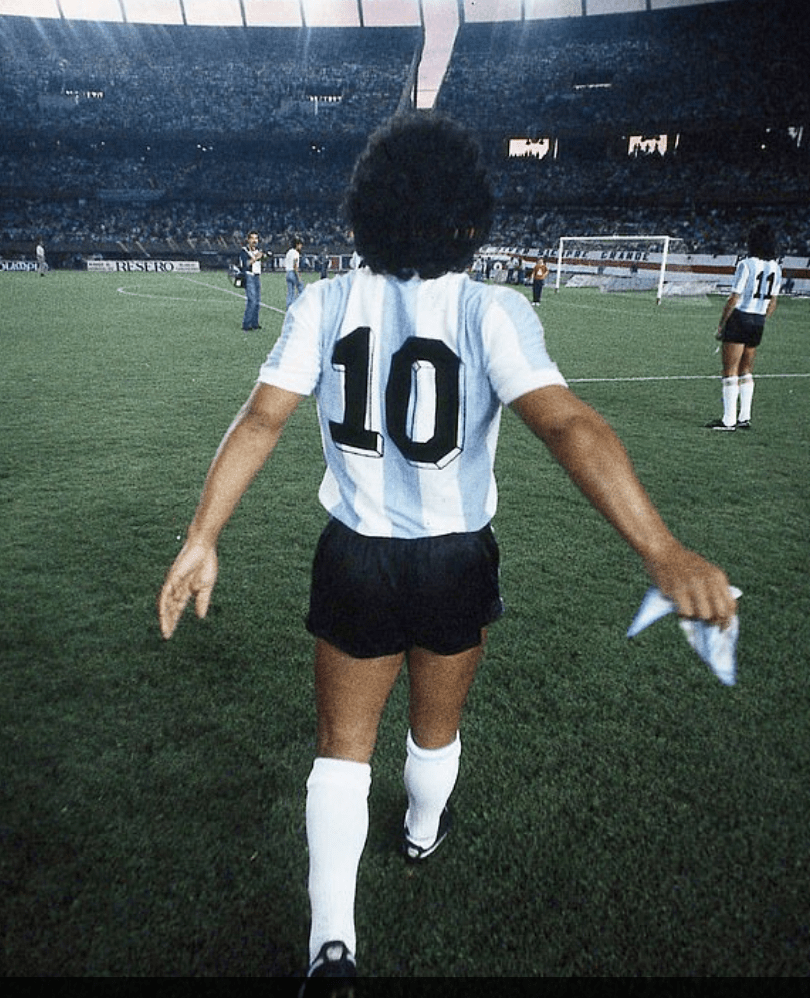
The classic No.10 did not disappear because football stopped valuing creativity. It disappeared because football stopped tolerating specialists who only played in one phase of the game.
For decades, the No.10 was football’s most romantic role.
The player between midfield and attack was allowed to drift, pause, improvise and unlock matches. Maradona, Baggio, Zidane, Rui Costa, Riquelme, Totti and Özil all represented different versions of the same idea: the central artist operating in the pocket behind the striker. Their job was not to obey the system. Their job was to bend it.
Modern football has made that harder. The spaces once reserved for the No.10 are now the most heavily protected areas on the pitch. Defensive blocks are narrower. Midfields are more athletic. Centre-backs step forward aggressively. Full-backs invert into central zones. Pressing schemes are designed to deny time on the half-turn. The classic No.10 depended on receiving centrally, facing forward, with a second of time. Modern football attacks all three conditions.
FIFA’s 2022 World Cup tactical analysis helps explain the change. The FIFA Technical Study Group highlighted the rise of compact mid-blocks, with all four semi-finalists using the mid-block as their dominant out-of-possession approach. The purpose was clear: deny central access, stay compact between the lines and force opponents into less dangerous areas. That is bad news for a traditional No.10. His natural habitat — the central pocket between midfield and defence — is now surrounded by bodies.
The change is also visible in the evolution of the No.9. FIFA’s analysis of the 2022 World Cup found that No.9s made more offers in behind than in 2018 and scored more efficiently despite fewer attempts. This matters because it shows how attacking responsibility has moved. Instead of building everything around a central playmaker feeding a striker, modern teams increasingly stretch opponents with depth, width and coordinated rotations. The striker threatens behind, the wingers hold width, the No.8s attack the half-spaces, and the full-backs or pivots help construct play from deeper zones.
The No.10 has not vanished so much as been redistributed. His passing now lives in deep midfielders. His dribbling lives in inverted wingers. His final ball lives in high No.8s. His spatial occupation lives in false nines and half-space creators. The modern creator is not one free player behind a striker; he is a network spread across the team.
UEFA’s Euro 2024 report captured this shift well through Spain. Spain’s creativity did not belong to one classic playmaker. Rodri controlled tempo from deeper areas, Fabián Ruiz progressed play, Dani Olmo received between the lines, and Nico Williams and Lamine Yamal created width and 1v1 threat. UEFA highlighted Spain’s use of wingers, midfield balance and ability to find pockets as key tournament features. This is the modern model: creativity by structure, not by indulgence.
The Euro 2024 final gave a sharp example. England’s compact midfield approach limited Spain in the first half, holding them to five shots worth only 0.29 expected goals. Spain’s solution came after Rodri’s injury, when Fabián dropped deeper next to Martín Zubimendi and Dani Olmo found more space in advanced pockets. The old No.10 would have been expected to solve the match through individual genius. The modern solution was structural: adjust the midfield shape, create new passing angles, then free the advanced player.
Opta’s player data also shows the modern attacking midfielder’s expanded responsibilities. In a comparison of Kevin De Bruyne and Martin Ødegaard, Opta Analyst noted not only their creative qualities but also their pressing profiles. De Bruyne applied fewer pressures overall than Ødegaard in the sample, but 48% of his pressures were in the final third compared with 28% for Ødegaard, reflecting differences in team style and role. That is the point: modern creators are judged not just by assists, but by where and how they press.
Opta’s 2022/23 Premier League player-ratings work also showed how creative midfielders are now measured across wider outputs. Ødegaard was not only a scorer and creator; he ranked highly for open-play expected assists and topped the league for successful passes in the final third. That is a very different profile from the old luxury No.10. The modern version must create, press, receive under pressure, circulate possession and contribute to territory.
CIES Football Observatory’s role-based approach to technical profiling reinforces this wider shift. CIES argues that player evaluation is increasingly based on the actions players perform within specific roles rather than on fixed positional labels. This is exactly what happened to the No.10. The shirt number became less important than the function. Is the player a creator? A receiver? A final-third passer? A line-breaker? A presser? A box attacker? Modern football breaks the old role into measurable tasks.
That is why the classic No.10 struggles. He often needs defensive protection. He wants freedom from pressing duties. He wants central access without constant structural work around him. In the 1990s or early 2000s, teams accepted that trade-off because elite chance creation was rare. Now, chance creation can come from full-backs, wingers, No.8s, false nines and deep playmakers. The one-player creative monopoly has been broken.
This is not necessarily a victory for football. Something has been lost. The old No.10 carried theatre. Riquelme walking through a match at his own tempo. Özil receiving sideways and slipping a pass nobody else saw. Totti dropping off, turning, and becoming both striker and playmaker. These players gave football a different rhythm. They did not always fit the system, and that was partly the point.
But modern football is ruthless. It demands contribution in every phase. The best attacking midfielders now press like forwards, defend like midfielders, create like No.10s and score like second strikers. The pure artist has been replaced by the multifunctional technician.
The classic No.10 is dead as a protected tactical species. But his qualities survived. They are now scattered across the pitch: in the inverted winger’s dribble, the No.8’s through ball, the pivot’s line-breaking pass, the full-back’s central progression and the striker’s lay-off. The throne disappeared. The artistry did not.
Data & Technical Sources Used
- FIFA Training Centre — World Cup 2022 tactical analysis: mid-blocks and compactness
- FIFA Training Centre — World Cup 2022 analysis of the modern No.9
- UEFA — Euro 2024 Technical Report / final tactical analysis
- Opta Analyst — Kevin De Bruyne vs Martin Ødegaard comparison
- Opta Analyst — Premier League creative midfielder / player ratings data
- CIES Football Observatory — Role-based technical profiling of players
- The Coaches’ Voice — Tactical role explainers on attacking midfielders and the No.10 role


Leave a comment