
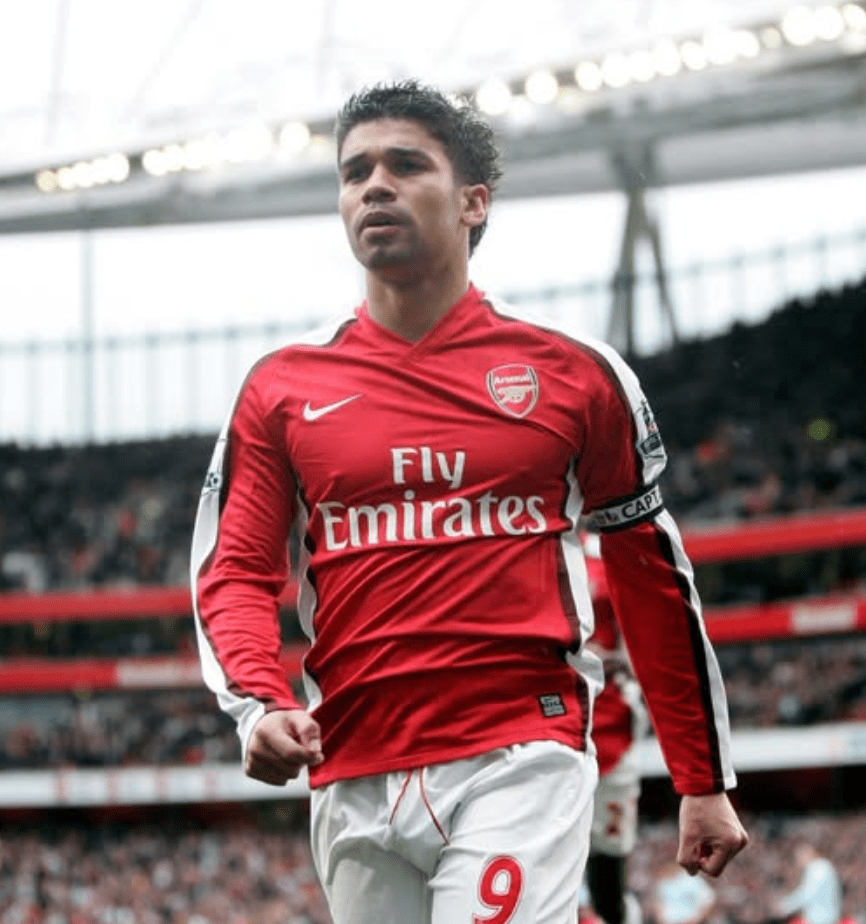
There was nothing loud about Eduardo da Silva. No exaggerated swagger, no theatre, no need to dominate the camera. He was a striker of small movements and sudden punishments; the kind of forward who could disappear between centre-backs, arrive half a second early, and finish before the goalkeeper had properly set his feet.
For Arsenal, he felt like something they had been missing. In a side full of rhythm, passing patterns and beautiful approach play, Eduardo offered the cold final touch. He was not there to decorate moves. He was there to end them.
That is what makes his story so painful. Eduardo did not fail to understand elite football. He looked built for it. Then, in one afternoon at St Andrew’s, the future Arsenal thought they had bought was violently interrupted.
The Beginning
Born in Rio de Janeiro in 1983, Eduardo moved to Croatia as a teenager and built his career at Dinamo Zagreb. It was not an obvious route to Premier League attention, but his numbers became impossible to ignore.
At Dinamo, he developed into a ruthless penalty-box striker: sharp across defenders, intelligent with his body shape, calm in front of goal and technically clean enough to combine in tight spaces. He was Brazilian by birth, Croatian by footballing identity, and by the time Arsenal came calling in 2007, he had become one of the most feared forwards in Croatian football.
His 2006/07 season was the one that changed everything. Eduardo scored a Croatian league record 34 goals in 32 appearances, breaking Goran Vlaović’s long-standing mark. It was the kind of domestic dominance that forced bigger clubs to look beyond the league and ask whether the finishing would translate elsewhere.
Arsenal had already seen the evidence up close. Eduardo scored against them for Dinamo Zagreb in Champions League qualifying at the Emirates. He had also scored for Croatia against England. This was not simply a striker bullying weaker opposition; this was a player with timing, nerve and a habit of appearing in important moments.
Why Expectations Were So High
Eduardo arrived at Arsenal in the summer of 2007, just after Thierry Henry had left for Barcelona. That context mattered. Arsenal were not replacing Henry directly — nobody could — but they needed a new source of goals in a young, evolving team built around Cesc Fàbregas, Emmanuel Adebayor, Robin van Persie, Alexander Hleb and Tomáš Rosický.
Eduardo looked like the missing piece.
He was not explosive like Henry or physically dominant like Adebayor. His gift was efficiency. Give him half a yard and he would manufacture a finish: left foot, right foot, first time, dink, volley, header. His movements were subtle, but his instincts were brutal.
Even before Arsenal, his potential had been recognised by serious football people. Jonathan Wilson once recalled Slaven Bilić speaking about Eduardo at Croatia Under-21 level, saying he had someone who could “slot into the Manchester United side without any problems.” That was the level of belief around him.
Eduardo himself understood why Arsenal could suit him. He spoke about the club’s passing style and how their football on the floor matched the way he wanted to play. In theory, it was a perfect fit: a precision finisher joining a team that created chances through combinations, cutbacks and quick central passing.
The Peak
Eduardo’s Arsenal peak was short, but it was beginning to feel real. After a period of adaptation, he started to find rhythm during the winter of 2007/08. Cup goals helped him settle, but his league performances began to show why Wenger had wanted him. He scored twice at Everton in December 2007, then produced one of his most memorable Arsenal moments away at Manchester City: an improvised, over-the-shoulder finish that summed up his strange mixture of calm and invention.
By February 2008, Arsenal were top of the Premier League and playing some of the most fluid football in Europe. Eduardo was not the headline star of that side, but he was becoming its most natural finisher. Arsenal’s historic profile of him would later describe him as possibly the club’s most clinical finisher since Ian Wright. That is not a casual compliment.
For a team sometimes accused of wanting to pass the ball into the net, Eduardo offered something different. He did not need the perfect goal. He only needed the chance.
The Demise
On 23 February 2008, everything changed.
Three minutes into Arsenal’s match away to Birmingham City, Eduardo suffered a broken leg and dislocated ankle after a challenge from Martin Taylor. The injury was so severe that it became one of the defining images of Arsenal’s late-Wenger years, even for those who never wanted to see it again.
Arsenal drew 2-2 that day. William Gallas sat on the pitch at full-time, broken by the emotion of the afternoon and the late equaliser. The title race shifted. The mood around Arsenal shifted. And Eduardo’s career shifted most of all.
He returned almost a year later in an FA Cup replay against Cardiff City and scored twice. After the match, he called it “the best day of my life” because he had proved he could play football again. It was a beautiful moment, but it was also revealing. The target had changed. Before the injury, the question had been how great Eduardo could become. After it, the question was whether he could simply be Eduardo again.
He never fully was.
The sharpness dulled. The body that once moved instinctively now had history inside it. There were further injuries, disrupted rhythm, and eventually a tactical problem too. Arsenal moved increasingly towards a 4-3-3, and Eduardo was not a natural wide forward or lone striker in the way the system demanded. In 2010, he left for Shakhtar Donetsk.
Why It Was So Unfortunate
Eduardo’s story hurts because it was not about attitude, ego or wasted professionalism. It was not a player throwing away his gift. It was a career altered by violence, timing and bad luck.
Arsenal could have used him. Croatia could have used him. Football could have used more of that rare striker who seemed to slow the penalty box down while everyone else panicked.
Years later, Eduardo said he believed Arsenal would have won the 2007/08 Premier League had he not suffered the injury. That may be impossible to prove, but it is easy to understand why he felt it. Arsenal had momentum, belief and a finisher who was just beginning to belong.
Legacy
Eduardo still had a good career. He played for Croatia, represented Arsenal, won trophies elsewhere and produced moments that fans remember with genuine affection. But this series is not about whether a player achieved nothing. It is about the space between what happened and what seemed possible.
With Eduardo, that space is painful.
He was not football’s loudest lost talent. He was not its most chaotic. He was something sadder: a player who looked ready, who found the right club, in the right team, at the right moment — until one tackle changed the story.
For Arsenal fans, Eduardo remains more than a memory of injury. He is a memory of a finish that never got the years it deserved.
Sources
Arsenal.com – Eduardo da Silva player profile
https://www.arsenal.com/historic/players/eduardo-da-silva
The Guardian – Arsenal sign Eduardo da Silva from Dinamo Zagreb
https://www.theguardian.com/football/2007/jul/02/newsstory.arsenal
UEFA – Eduardo: “The best day of my life”
https://www.uefa.com/uefachampionsleague/news/01d6-0e70d93bffda-b138329835b7-1000–eduardo-the-best-day-of-my-life/
GNK Dinamo Zagreb – Dinamo v Hajduk 3-0, Eduardo’s record-breaking season
https://gnkdinamo.hr/en/timeline/294
National Football Teams – Eduardo da Silva international and club statistics
https://www.national-football-teams.com/player/9609/Eduardo_Da_Silva.html


Leave a Reply