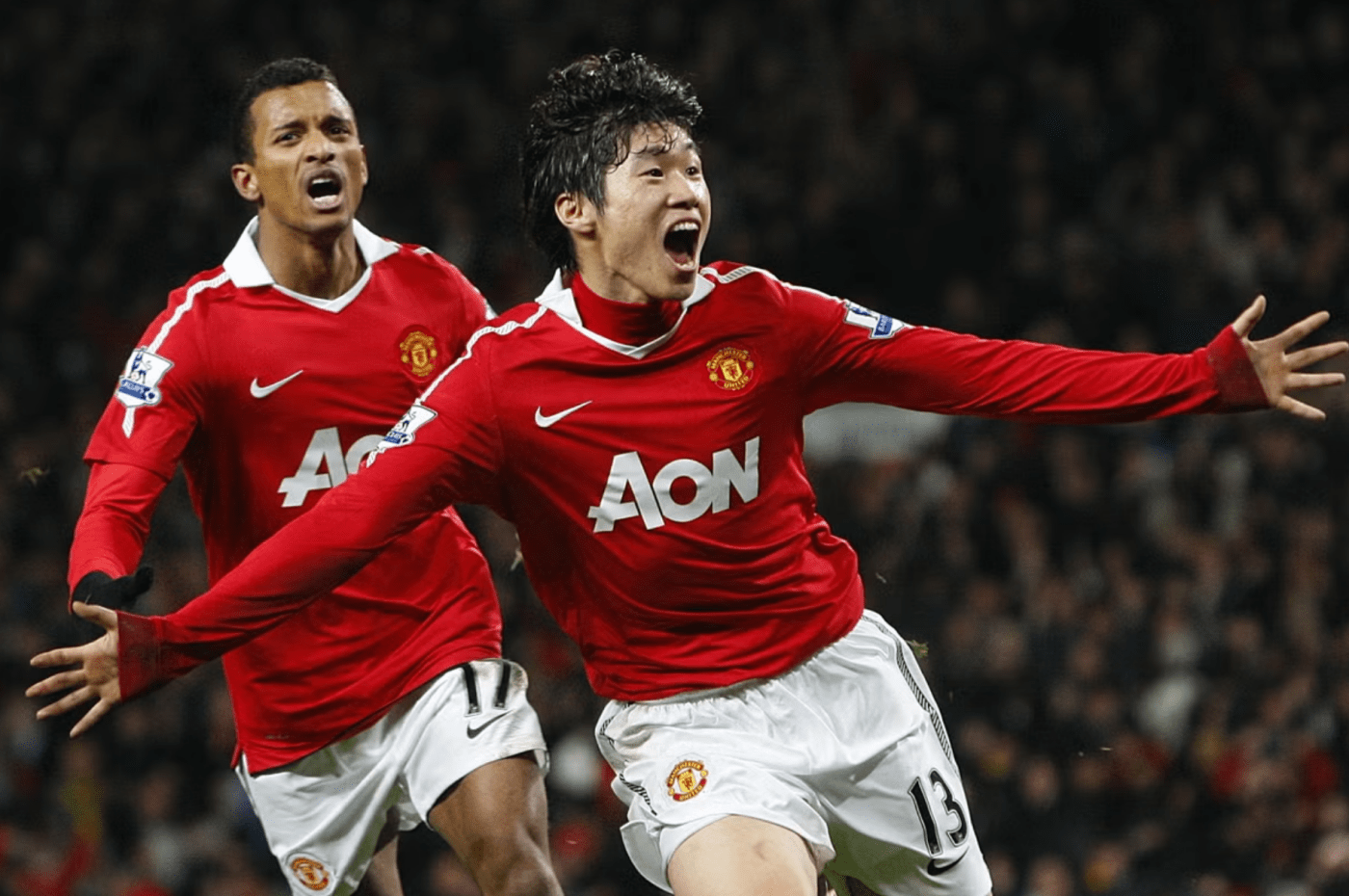
There are players whose value announces itself through numbers, highlights and individual awards.
Park Ji-sung’s value lived somewhere quieter. It was in the passing lane he closed before it became dangerous, the full-back he protected before the overload arrived, the midfielder he harassed until the rhythm disappeared. He was not Manchester United’s most gifted player, nor their most marketable star, but in some of the biggest matches of Sir Alex Ferguson’s final great era, Park was one of the players who made the whole machine feel secure.
At a club built around Cristiano Ronaldo’s explosion, Wayne Rooney’s force, Ryan Giggs’ longevity, Paul Scholes’ passing and Rio Ferdinand’s elegance, Park became something different: the manager’s tactical insurance policy. He was the player selected when United needed control without becoming passive, energy without chaos, discipline without losing attacking threat.
That is why he belongs in the Unsung Heroes series. Park was never just a hard worker. That description, while true, undersells him badly. He was a system player in the best possible sense — intelligent, selfless, technically reliable enough to survive at the highest level, and tactically sharp enough to be trusted in matches where one mistake could reshape a European season.
The Role He Played
Park arrived at Manchester United from PSV Eindhoven in 2005, having already shown his European-level pedigree under Guus Hiddink. At PSV, he had been part of a side that pushed AC Milan to the edge in the 2004/05 Champions League semi-final, even scoring in the second leg. That performance mattered. It showed that Park could live in elite tactical environments: pressing, linking play, arriving at the right moments and maintaining concentration against superior individual talent.
At United, his role was rarely fixed to one simple position. He could play wide left, wide right, as a narrow midfielder, or as part of a more compact European structure. Ferguson did not use him as a traditional winger who hugged the touchline and beat players repeatedly. Park was more often a balancing piece. He tucked in when United needed an extra body in midfield. He pressed full-backs and deep midfielders. He protected his own full-back. He made diagonal runs to create space for others. He allowed more expressive teammates to take risks because he was already thinking about the consequences if possession was lost.
This made him particularly valuable in Europe. Ferguson’s United sides in that period could be devastating in transition, but Champions League knockout football demanded more than speed and attacking quality. It demanded discipline, compactness and the ability to suffer without collapsing. Park gave United that. He was a player who could help turn a 4-4-2 into something closer to a 4-3-3 without a substitution, simply through his movement and defensive awareness.
Playing Style and Strengths
Park’s game was built around stamina, anticipation and humility, but those qualities only became elite because they were attached to intelligence. Plenty of players run. Far fewer know where to run, when to press, when to hold, when to track inside, and when to leave their position to create pressure elsewhere.
His defensive work was proactive rather than desperate. He did not simply chase the ball; he hunted triggers. A poor first touch, a pass into a player facing his own goal, a centre-back shaping to play into midfield — Park recognised these moments quickly. Once he pressed, he did it with commitment, but rarely in a way that broke the team’s structure. That is what made him so useful. He could raise United’s intensity without turning the match into a sprinting contest.
On the ball, he was not spectacular, but he was effective. His first thought was often to connect rather than decorate. He played quick passes around pressure, recycled possession, made third-man runs and found space between defenders who were more concerned with United’s bigger names. His movement was one of his most underrated weapons. Park had a knack for arriving in the box unnoticed because defenders did not treat him as the main threat until it was too late.
Physically, he was relentless. His nickname, “Three-Lung Park”, became shorthand for his endurance, but again, the phrase can make him sound like a novelty. He was not valuable because he ran more than everyone else. He was valuable because his running had purpose. He covered the spaces elite teams are built to exploit: the channel beside a holding midfielder, the zone behind an attacking full-back, the passing lane into a playmaker.
Mentally, he was almost perfectly suited to Ferguson. He accepted roles that were demanding and sometimes thankless. He could be left out for weeks and still perform when selected. He did not need the game to revolve around him. In a squad full of stars, that mattered.
Why He Was Underappreciated
Park was underappreciated partly because his best work often happened before the obvious action. He prevented passes that were never made. He blocked routes that never became chances. He wore down opponents in ways that did not appear in highlight reels.
He was also surrounded by huge personalities and elite attackers. During his United years, the headlines naturally went elsewhere: Ronaldo’s rise, Rooney’s aggression, Scholes’ passing, Tevez’s intensity, Giggs’ reinvention, Van der Sar’s calm, Ferdinand and Vidic’s defensive authority. Park did not have one easily marketable signature move. He was not a luxury footballer. He was a manager’s footballer.
There was also a tendency to reduce him to work rate, especially in English football. That missed the point. Park’s importance was tactical. Ferguson trusted him not because he was simply willing to run, but because he understood instructions and carried them out under pressure. His value was clearest to coaches, teammates and opponents — the people who feel the weight of those small details inside a match.
Impact on Team Success
Park’s Manchester United career coincided with one of the club’s strongest modern periods. He won four Premier League titles, the Champions League, the FIFA Club World Cup and multiple domestic cups. His Premier League record of 154 appearances and 19 goals does not scream superstar status, but that was never the full measure of his contribution.
His importance was especially clear in Europe. He played a role in United’s run to the 2008 Champions League final, featuring in the quarter-final and semi-final stages before being left out of the final squad against Chelsea — a decision Ferguson later described as one of the hardest of his career. That omission became a painful part of Park’s story, but it also underlined his importance. He had done the unglamorous work that helped United reach Moscow.
By 2010 and 2011, his reputation as a big-game player was firmly established. Ferguson used him in matches where United needed to disturb elite opponents rather than simply outscore them. Park’s job was often to tilt the tactical balance: stop a key passer, protect a vulnerable flank, add a third midfield presence, or make United harder to play through.
That kind of player is not always loved by casual viewers, but title-winning teams depend on them. Stars decide moments. Players like Park make sure those moments arrive in the right conditions.
Defining Matches and Moments
The obvious Park performance is Manchester United’s Champions League meeting with AC Milan in 2010, when he was tasked with limiting Andrea Pirlo’s influence. Pirlo, one of the greatest deep playmakers of his generation, needed time and angles to control matches. Park denied him both. He stayed close, pressed intelligently and disrupted Milan’s usual rhythm. It was not a performance built for a compilation, but it was a tactical masterclass in concentration and sacrifice.
Another defining moment came against Chelsea in the 2010/11 Champions League quarter-final. Park scored at Old Trafford almost immediately after Didier Drogba had given Chelsea hope, restoring United’s control in a tie that could have turned nervy. It was classic Park: arriving at the right time, in the right space, when the match needed someone other than the obvious stars to act decisively.
His PSV goal against Milan in 2005 also deserves mention. It came before the Premier League fully knew him, but it showed the same qualities that would later define him at United: energy, timing, courage and the ability to affect elite matches without needing to dominate the ball.
Legacy
Park Ji-sung should be remembered as one of the great tactical role players of the modern Premier League era. Not because he lacked talent, but because he used his talent in service of the team. He understood that football is not only about what you do with the ball, but what you deny the opposition, what you enable for teammates, and how reliably you can execute a plan when the pressure is highest.
His legacy is also bigger than Manchester United. As one of Asia’s most successful footballers, he helped widen the imagination of what was possible for players from the continent at the highest level of European football. But his footballing legacy should not be reduced to representation alone. Park earned his place because he was trusted in elite matches by one of the greatest managers of all time.
He was not always the headline act. He was not always the player supporters discussed first. But when Manchester United needed legs, discipline, intelligence and courage in the biggest games, Park Ji-sung was often exactly the player Ferguson wanted.
That is the essence of an unsung hero: not invisible, not ordinary, but essential in ways that only become obvious when you understand how great teams really work.
Sources / Further Reading
- Manchester United official profile — Park Ji-sung’s United career overview, role at the club, major honours and legacy.
https://www.manutd.com/en/players-and-staff/detail/ji-sung-park - Premier League official profile — Park’s league appearances, goals and overall Premier League record with Manchester United.
https://www.premierleague.com/players/2916/Ji-Sung-Park/overview - UEFA Champions League records and match reports — Useful for Park’s European performances, including PSV’s 2004/05 run and Manchester United’s Champions League campaigns.
https://www.uefa.com/uefachampionsleague/ - The Guardian football analysis — Context on Park’s tactical value, big-game role under Sir Alex Ferguson and his reputation as a disciplined European specialist.
https://www.theguardian.com/football - Transfermarkt profile — Helpful supporting reference for career timeline, clubs, appearances, positions and honours.
https://www.transfermarkt.com/ji-sung-park/profil/spieler/25477
 FourFiveOne
Leave a comment