

Hosts, Heavyweights and a Potential Brazil–Morocco Classic
The opening three groups of the 2026 World Cup contain two host nations, the five-time champions Brazil, 2022 semi-finalists Morocco and several countries returning after long absences.
Mexico and Canada will carry the pressure of playing at home. Brazil remain Group C favourites, but Morocco are equipped to challenge them directly. Elsewhere, Korea Republic, Switzerland and Scotland possess credible routes into the knockout stage.
With the top two teams in each group and eight of the 12 third-placed sides advancing, avoiding heavy defeats could prove almost as important as winning matches.

FIFA confirmed that Group A consists of Mexico, South Africa, Korea Republic and Czechia.
Mexico — FIFA ranking: 15
Mexico enter their 18th World Cup with considerable home support and the expectation of reaching at least the knockout rounds.
Their strongest areas are central defence and midfield. Edson Álvarez provides aggression and positional discipline, Santiago Giménez offers penalty-box movement, while the emergence of Gilberto Mora gives Mexico a gifted young creator capable of receiving between the lines.
Mexico will generally attempt to control possession through a 4–3–3 or 4–2–3–1. The full-backs advance, the midfield circulates the ball patiently and the wide players attempt to create isolations.
Players to watch: Edson Álvarez, Santiago Giménez, Gilberto Mora and Johan Vásquez.
Strengths: Home advantage, technical midfielders, tournament experience and a strong central defensive core.
Weaknesses: Mexico can dominate possession without creating enough clear chances. They may also leave space behind their full-backs when both advance.
South Africa — FIFA ranking: 60
South Africa return to the World Cup for the first time since hosting the tournament in 2010.
Bafana Bafana’s progress has been built around organisation, confidence in possession and the influence of Mamelodi Sundowns’ successful club structure. Teboho Mokoena gives them passing range and set-piece quality, while Lyle Foster provides a direct attacking outlet.
They are likely to defend in a compact 4–2–3–1 before breaking quickly through the wide areas.
Players to watch: Teboho Mokoena, Lyle Foster, Ronwen Williams and Evidence Makgopa.
Strengths: Familiarity between players, midfield discipline, goalkeeping and dangerous set pieces.
Weaknesses: Limited depth at the highest level and occasional difficulty creating chances against organised defensive blocks.
Korea Republic — FIFA ranking: 25
Korea Republic possess the group’s most recognisable individual attacker in Son Heung-min, although the team can no longer depend exclusively on its long-serving captain.
Lee Kang-in brings creativity and delivery, Kim Min-jae anchors the defence and Hwang Hee-chan provides direct running. Korea can play with pace, but their most important development has been an improved ability to construct attacks through midfield.
Players to watch: Son Heung-min, Lee Kang-in, Kim Min-jae and Hwang Hee-chan.
Strengths: Speed, technical quality, international experience and threatening movement in transition.
Weaknesses: Overreliance on key individuals and vulnerability when their midfield press is bypassed.
Czechia — FIFA ranking: 41
Czechia qualified through the European play-offs and arrive as a physically strong, tactically disciplined opponent.
Patrik Schick offers an established scoring threat, Tomáš Souček dominates aerially and goalkeeper Matěj Kovář can support the build-up. Czechia may use a back three, attack through wing-backs and look for Schick early.
Players to watch: Patrik Schick, Tomáš Souček, Adam Hložek and Matěj Kovář.
Strengths: Aerial power, defensive organisation, set pieces and a proven centre-forward.
Weaknesses: Limited pace in some defensive areas and an attack that can become predictable when Schick is isolated.
Group A prediction
- Mexico
- Korea Republic
- Czechia
- South Africa
Mexico’s home advantage should carry them through, but the competition for second place is extremely close. Czechia could qualify as one of the best third-placed teams.

Canada face Bosnia and Herzegovina, Qatar and Switzerland in a group that provides the co-hosts with a genuine opportunity to record their first World Cup victories and reach the knockout rounds.
Canada — FIFA ranking: 30
Canada’s leading qualities are pace, athleticism and vertical attacking.
Alphonso Davies can transform a match from left-back, wing-back or further forward. Jonathan David offers intelligent movement, while Tajon Buchanan and Jacob Shaffelburg stretch opponents.
Canada are most dangerous when they regain possession and attack before the opposition can reorganise.
Players to watch: Alphonso Davies, Jonathan David, Tajon Buchanan and Stephen Eustáquio.
Strengths: Speed, home support, counter-attacking quality and several players in leading European leagues.
Weaknesses: Defensive concentration, vulnerability against crosses and a tendency to become too open when chasing a match.
Bosnia and Herzegovina — FIFA ranking: 65
Bosnia return to the World Cup after defeating Italy in the European play-offs.
Their younger generation is led by Ermedin Demirović, Amar Dedić and Benjamin Tahirović. Edin Džeko’s role may now be more limited, but his leadership and penalty-box intelligence remain valuable.
Bosnia will likely defend compactly, use Dedić to advance from full-back and target Demirović with early passes.
Players to watch: Ermedin Demirović, Amar Dedić, Benjamin Tahirović and Edin Džeko.
Strengths: Physicality, emotional resilience and several technically capable central players.
Weaknesses: Limited squad depth, questions over defensive pace and dependence on a small number of attacking threats.
Qatar — FIFA ranking: 55
Qatar are appearing at a World Cup through qualification for the first time.
Akram Afif remains their creative centrepiece. His movement, dribbling and combination play with Almoez Ali provide Qatar with a clear attacking identity.
They may use a 3–5–2 or 5–3–2, protect central areas and release Afif into the spaces behind opposing midfielders.
Players to watch: Akram Afif, Almoez Ali, Homam Ahmed and Meshaal Barsham.
Strengths: Technical combinations, tactical familiarity and an established attacking partnership.
Weaknesses: Physical vulnerability, limited depth and difficulty coping with sustained pressure from quicker opponents.
Switzerland — FIFA ranking: 19
Switzerland enter as the highest-ranked and most experienced team in the group.
Granit Xhaka dictates the tempo, Manuel Akanji leads the defence and Dan Ndoye provides penetration from wide or central positions. Switzerland are comfortable changing between a back three and back four.
Players to watch: Granit Xhaka, Manuel Akanji, Dan Ndoye and Gregor Kobel.
Strengths: Tactical intelligence, midfield control, defensive quality and extensive tournament experience.
Weaknesses: They sometimes lack a ruthless goalscorer and can become overly cautious after taking the lead.
Group B prediction
- Switzerland
- Canada
- Qatar
- Bosnia and Herzegovina
Switzerland’s control should make them favourites, but Canada’s home matches provide an excellent opportunity to progress.
Group C: Brazil, Morocco, Haiti and Scotland
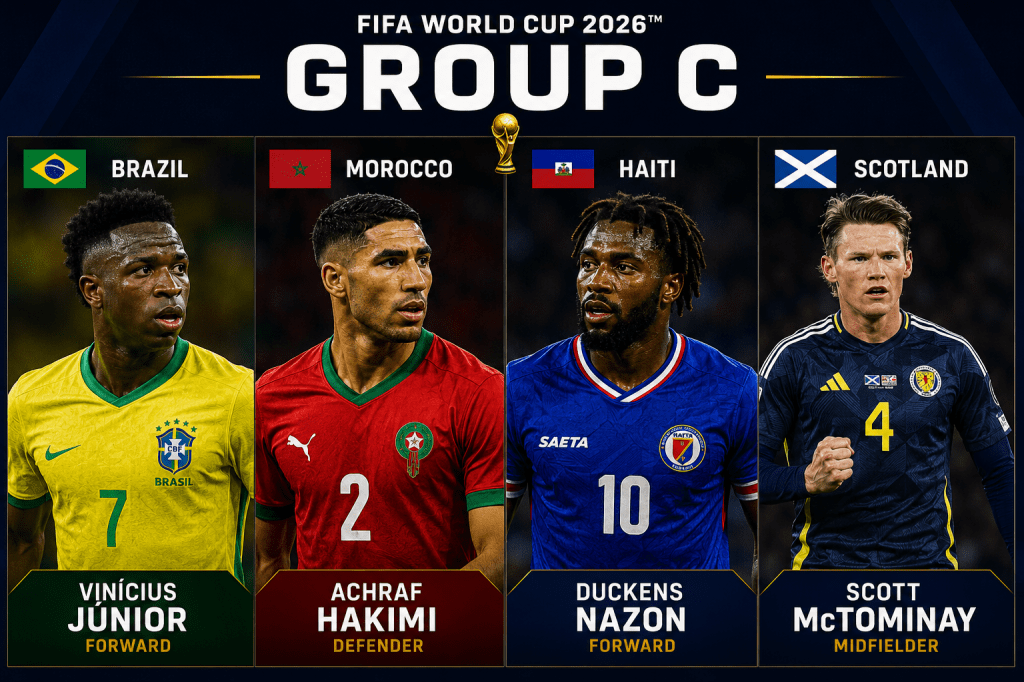
Group C contains one of the most anticipated opening matches of the tournament when Brazil meet Morocco. Scotland and Haiti complete a group carrying considerable historical and emotional significance.
Brazil — FIFA ranking: 6
Brazil are attempting to win their first World Cup since 2002 under Carlo Ancelotti.
Vinícius Júnior is the leading transition threat, while Rodrygo, Raphinha, Bruno Guimarães and the returning Neymar provide different forms of creativity. Brazil’s challenge is to convert attacking talent into a balanced collective structure.
Players to watch: Vinícius Júnior, Neymar, Bruno Guimarães and Gabriel Magalhães.
Strengths: Elite individual talent, one-against-one ability, defensive depth and attacking variety.
Weaknesses: An unsettled centre-forward role, occasional midfield imbalance and pressure created by more than two decades without winning the tournament.
Morocco — FIFA ranking: 8
Morocco’s 2022 semi-final was not an isolated accident. Their squad now contains greater depth and attacking quality.
Achraf Hakimi remains central to their right-sided progression. Brahim Díaz operates between midfield and attack, while Noussair Mazraoui and Sofyan Amrabat contribute experience and tactical discipline.
Players to watch: Achraf Hakimi, Brahim Díaz, Sofyan Amrabat and Bilal El Khannouss.
Strengths: Defensive organisation, technical midfielders, rapid transitions and strong tournament belief.
Weaknesses: Their centre-forward options are less convincing than their wide and midfield talent, and they can struggle when required to dominate possession.
Haiti — FIFA ranking: 83
Haiti’s return after 52 years is one of the tournament’s most remarkable stories.
They qualified despite being unable to play home matches in Haiti. Their squad has been strengthened by diaspora recruitment, with Jean-Ricner Bellegarde providing midfield quality and Duckens Nazon offering experience in attack.
Players to watch: Duckens Nazon, Jean-Ricner Bellegarde, Frantzdy Pierrot and Johny Placide.
Strengths: Team spirit, direct attacking, physical commitment and freedom from external expectation.
Weaknesses: Limited depth, defensive exposure against elite attackers and relatively little experience at this level.
Scotland — FIFA ranking: 43
Scotland return to the World Cup for the first time since 1998.
Scott McTominay is now a genuine attacking midfielder rather than simply a defensive screen. John McGinn brings leadership and ball-carrying, while Andy Robertson remains important on the left.
Players to watch: Scott McTominay, John McGinn, Andy Robertson and Ben Doak.
Strengths: Midfield physicality, set pieces, collective spirit and aggressive wing-back play.
Weaknesses: Billy Gilmour’s reported injury reduces midfield control, while Scotland still lack a consistently prolific international striker.
Group C prediction
- Brazil
- Morocco
- Scotland
- Haiti
Brazil and Morocco should advance, but Scotland’s set pieces and physicality give them a strong chance of progressing from third place.


Leave a Reply