
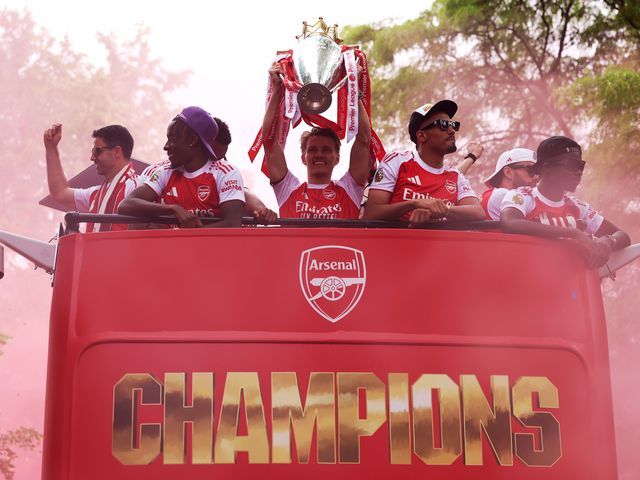
There was a time—not even that long ago—when Arsenal finishing fourth felt like an achievement worthy of emotional montages, commemorative merchandise and at least one speech about getting the club “back where it belongs”.
In May 2026, Arsenal finally completed the journey.
Mikel Arteta’s side are Premier League champions for the first time since the Invincibles of 2003/04, ending a 22-year wait for the title. After finishing second in three consecutive seasons, Arsenal secured the 2025/26 championship with 85 points, seven clear of Manchester City. They won 26 of their 38 matches, scored 71 goals and conceded only 27—the best defensive record in the division. [1]
This was not a surprise title produced by an unusually favourable season. It was the culmination of a long, deliberate rebuild in which Arsenal progressively improved their squad, physicality, tactical flexibility and defensive resilience.
The “process” has officially produced a product.
Five Years of Relentless Progress
Arteta’s reconstruction becomes clearer when Arsenal’s last five Premier League campaigns are viewed together.
Arsenal’s Premier League progression
| Season | Position | Points | Goals scored | Goals conceded | Goal difference |
|---|---|---|---|---|---|
| 2021/22 | 5th | 69 | 61 | 48 | +13 |
| 2022/23 | 2nd | 84 | 88 | 43 | +45 |
| 2023/24 | 2nd | 89 | 91 | 29 | +62 |
| 2024/25 | 2nd | 74 | 69 | 34 | +35 |
| 2025/26 | 1st | 85 | 71 | 27 | +44 |
The trajectory has not been perfectly linear, but the direction is unmistakable.
In 2021/22, Arsenal were a promising team still vulnerable to inconsistency, scoring 61 goals and conceding 48. One year later, their attack exploded: 88 goals, 84 points and an unexpected title challenge. In 2023/24, they improved again, recording 89 points, 91 goals and a goal difference of +62, only to finish two points behind Manchester City.
The 2024/25 campaign was less explosive. Arsenal scored 22 fewer league goals than in the previous season and finished with 74 points, but still came second while conceding only 34 times. Rather than representing the end of the project, it demonstrated how high the team’s floor had become: even in a comparatively uneven campaign, Arsenal remained England’s closest challengers.
The response in 2025/26 was decisive. Arsenal did not match the 91-goal attack of 2023/24, but they produced a more balanced title-winning team. They finished with 85 points, won their final five league matches and conceded only 27 goals across the entire season. [1]
The attack made Arsenal challengers. The defence made them champions.
Expected Goals: A Consistent Statistical Measure
Expected goals should not be calculated by working backwards from the final score. Each shot is assigned a probability of becoming a goal based on factors such as its location, angle, type of assist and whether it came from open play or a set piece.
A shot worth 0.20 xG would be expected to become a goal approximately 20 per cent of the time. A team’s season xG is the combined value of all its shots, while xGA is the combined value of every chance it allows its opponents.
Because different providers use different models, their totals can vary. The table below therefore uses StatMuse data exclusively across all five seasons, avoiding comparisons between incompatible models. [2]
Arsenal’s Premier League xG progression—StatMuse model
| Season | xG | xGA | xG difference |
|---|---|---|---|
| 2021/22 | 65.38 | 46.57 | +18.81 |
| 2022/23 | 73.96 | 42.14 | +31.82 |
| 2023/24 | 78.34 | 28.53 | +49.81 |
| 2024/25 | 62.90 | 35.02 | +27.88 |
| 2025/26 | 66.13 | 29.98 | +36.15 |
The improvement is substantial.
Arsenal’s xG difference increased from +18.81 in 2021/22 to +31.82 in their first serious title challenge. It then rose to an exceptional +49.81 in 2023/24, when Arsenal created chances worth almost 50 expected goals more than they conceded.
Although the attacking numbers fell in 2024/25, Arsenal remained strongly positive. In the title-winning season, their xG difference climbed back to +36.15. They generated 66.13 xG, allowed only 29.98 xGA and conceded 27 actual goals. Their average xGA was just 0.79 per league match. [2]
That does not mean Arsenal dominated every match. Champions rarely do. It means that, across 38 games, they consistently created better chances than their opponents while protecting their own goal at an elite level.
They stopped needing every match to be perfect. They simply made it increasingly difficult for the opposition to have a good one.
The Defensive Core: Where Arsenal’s Control Became Permanent
Arteta’s tactical structure is supported by a defensive spine built around Declan Rice, William Saliba, Gabriel Magalhães and David Raya.
Rice’s arrival in the summer of 2023 coincided with a major improvement in Arsenal’s defensive numbers. In the season before he joined, Arsenal conceded 43 league goals and allowed 42.14 xGA. Across his first three league campaigns, those figures fell to 29 goals and 28.53 xGA in 2023/24, 34 and 35.02 in 2024/25, and 27 and 29.98 in the title-winning season. [2]
Rice should not receive sole credit for a team statistic, but his role is fundamental. His capacity to recover possession, protect the spaces behind Arsenal’s attacking midfielders and cover large areas allows Arteta’s team to press aggressively without leaving its centre-backs permanently exposed. He has also added high-level set-piece delivery, making him both a defensive safeguard and an attacking weapon.
Behind Rice, Saliba and Gabriel have developed into one of Europe’s most authoritative centre-back partnerships. Saliba’s recovery speed and composure allow Arsenal to defend with a high line, while Gabriel provides front-foot aggression, penalty-area defending and a significant threat from attacking set pieces.
The most persuasive evidence of their collective impact lies in Arsenal’s team record. Across the three seasons since Rice joined and Saliba and Gabriel became firmly established as the central partnership, Arsenal have conceded 90 goals in 114 league matches—an average of 0.79 per game. Their combined xGA across the same period was 93.53, or 0.82 per match. [2]
Raya has completed that defensive platform. He won the Premier League Golden Glove in each of his first three seasons as Arsenal’s first-choice goalkeeper: 16 clean sheets in 2023/24, 13 in 2024/25 and a career-best 19 in 2025/26. His latest award came after 19 shutouts in 37 appearances. [3]
Across those three campaigns, Raya accumulated 48 league clean sheets. Arsenal conceded 90 league goals in that period, averaging 0.79 per match as a team. Raya’s distribution, positioning outside his penalty area and command of crosses have helped Arsenal defend higher and restart attacks more calmly.
He is not usually required to spend 90 minutes performing acrobatics. That is partly the point.
This is not simply a collection of good defenders. It is a connected defensive system in which Rice protects space, Saliba and Gabriel defend aggressively, and Raya controls what develops behind them.
Style of Play: Possession Was the Tool, Control Was the Objective
Arteta’s Arsenal are often described as a possession team, but possession alone does not explain their progression.
The earlier versions of Arsenal could dominate the ball while remaining vulnerable to counter-attacks. They were capable of pinning an opponent into its own half, then allowing one misplaced pass to turn a comfortable match into a fire drill.
The current side is built around control rather than possession for its own sake. Arsenal’s structure in possession is designed to support the attack and protect against transitions simultaneously. Full-backs or central defenders step into midfield, Rice positions himself to collect second balls, and Saliba and Gabriel remain close enough to engage forwards before counter-attacks gain momentum.
The statistical change is evident in the xGA totals. Arsenal allowed 46.57 xGA in 2021/22 and 42.14 in 2022/23. That fell dramatically to 28.53 in 2023/24. Even during the less fluent 2024/25 season, it remained at 35.02, before dropping to 29.98 during the title-winning campaign. [2]
Arteta has also made the team less dependent on one attacking method. Arsenal can build patiently through midfield, create overloads around Bukayo Saka, attack crosses, press high, counter into space or use set pieces to break a low block.
The football can still be attractive, but attractiveness is no longer the central requirement. Arsenal can win through control, pressure, defensive resistance or one decisive moment.
That is the difference between a team constructed to produce impressive performances and one constructed to survive a season.
Set Pieces: A Measurable Competitive Advantage
Set pieces have become central to Arsenal’s identity under specialist coach Nicolas Jover. However, claims about set-piece goals can vary depending on whether penalties, direct free-kicks, throw-ins and second-phase situations are included.
For consistency, the most reliable comparison is again StatMuse’s set-piece expected-goals measure.
Arsenal generated 14.91 set-piece xG in the Premier League in 2023/24, the highest figure in the division. That rose to 17.40 in 2024/25 and then to a league-leading 19.97 in the title-winning 2025/26 season. Across those three campaigns, Arsenal generated 52.28 set-piece xG. [4]
That progression is significant. Arsenal’s total xG fell between 2023/24 and 2024/25, yet their set-piece xG increased. It rose again during the championship season, accounting for more than 30 per cent of their overall 66.13 xG.
This was not a gimmick attached to the side. It was a repeatable method of creating high-value chances when open-play routes became congested.
The quality of Rice’s delivery, the movement of Gabriel and Saliba, and Arsenal’s carefully rehearsed blocking and spacing have made corners and free-kicks feel less like hopeful restarts and more like planned attacking possessions.
Some supporters may prefer a 20-pass move ending in a delicate finish. Arteta appears perfectly content with a corner, three obstructed defenders and Gabriel arriving like a removal van.
Titles do not award additional points for artistic interpretation.
Champions League Dominance in the League-Format Era
Arsenal’s domestic progression has been matched by a transformation in Europe.
The Champions League adopted its 36-team league phase in 2024/25. Arsenal finished third in the inaugural league table, winning six of their eight matches, drawing one and losing one. They scored 16 goals and conceded only three, finishing with 19 points and a goal difference of +13. [5]
They then produced the defining European result of Arteta’s tenure: a 5–1 aggregate victory over holders Real Madrid in the quarter-finals. Arsenal won the first leg 3–0 in London and the return match 2–1 at the Santiago Bernabéu. It was not a fortunate escape or a heroic defensive retreat. Arsenal comprehensively outperformed the reigning champions over two matches. [6]
Their run ended against Paris Saint-Germain in the semi-finals, but it established Arsenal as a genuine Champions League force.
The following season went considerably further.
Arsenal in the Champions League league phase
| Season | Position | Record | Points | G/Scored | G/Conceded | G/Difference |
|---|---|---|---|---|---|---|
| 2024/25 | 3rd | 6W, 1D, 1L | 19 | 16 | 3 | +13 |
| 2025/26 | 1st | 8W, 0D, 0L | 24 | 23 | 4 | +19 |
In 2025/26, Arsenal became the first club to win all eight matches since the league-phase format was introduced. They defeated Atlético Madrid 4–0, Bayern Munich 3–1 and Inter 3–1, as well as Athletic Club, Olympiacos, Slavia Prague, Club Brugge and Kairat Almaty. [7]
Across the two league phases, Arsenal therefore played 16 matches, won 14, drew one and lost one. They scored 39 goals, conceded only seven and collected 43 points from a possible 48.
That is not merely successful qualification. It is sustained dominance.
The defensive numbers are particularly striking. Arsenal conceded three league-phase goals in 2024/25 and four in 2025/26—less than half a goal per match across the two campaigns.
Their 2025/26 run continued through Bayer Leverkusen, Sporting CP and Atlético Madrid before Arsenal reached the Champions League final for only the second time in the club’s history. They entered the final unbeaten in the competition and took an early lead against Paris Saint-Germain before drawing 1–1 and losing 4–3 on penalties. [8]
The result was painful, but the wider conclusion was unavoidable: Arsenal had become one of Europe’s strongest tournament teams.
In 2024/25, they eliminated Real Madrid 5–1 over two legs. In 2025/26, they won every league-phase match, beat Bayern, Inter and Atlético, reached the final without losing a match in regulation time, and finished the competition with 30 goals scored, seven conceded and nine clean sheets across 15 games. [9]
The old Arsenal often entered major European matches carrying the weight of their history. Arteta’s team now enters them expecting to impose its own.
Big-Game Mentality: Evidence Rather Than Branding
“Big-game mentality” can become an empty phrase, particularly when it is based on one dramatic victory or an enthusiastic television montage.
Arsenal’s recent record gives the idea more substance.
They beat Real Madrid home and away in 2025. They defeated Bayern Munich, Inter and Atlético Madrid during a perfect Champions League league phase the following season. They then eliminated Leverkusen, Sporting and Atlético to reach the final. UEFA noted before the 2026 semi-finals that Arsenal had lost only two of their previous 22 Champions League matches. [10]
Domestically, Arsenal responded to three consecutive second-place finishes by winning the league rather than allowing the disappointment to dismantle the project. They secured the title before the final day and finished the campaign with five consecutive victories. [1]
This does not make Arsenal immune to pressure. The defeat to PSG demonstrated how narrow the margins remain at the highest level. What has changed is their capacity to perform within that pressure.
They no longer need an emotional surge to compete with elite opponents. They can defend, manage territory, slow the match, attack set pieces and execute a plan over two legs.
That is less cinematic than a miracle comeback. It is also more sustainable.
Consistency: The Foundation of the Championship
The Premier League title is the headline, but Arsenal’s consistency is what made it possible.
From 2022/23 through 2025/26, Arsenal finished second, second, second and first. Across those four campaigns they collected 332 points, averaging 83 per season. They won 100 of 152 league matches, scored 319 goals and conceded 133. [1]
Over the most recent three seasons, their defensive record became even stronger. Arsenal conceded 29 goals in 2023/24, 34 in 2024/25 and 27 in 2025/26—a total of 90 in 114 matches. Their xGA across the same period was 93.53, while their cumulative xG difference was +113.84. [2]
Raya won three consecutive Golden Gloves during those seasons. Arsenal generated the league’s highest set-piece xG in both 2023/24 and 2025/26. In Europe, they finished third and then first in the two Champions League league phases, losing only one of their 16 matches. [3][4][5][7]
These are not the numbers of a team briefly catching fire.
They describe a team whose standard has remained close to the top of English and European football for several years. The title did not suddenly transform Arsenal into an elite side. It confirmed what their performances had already been demonstrating.
From Inevitability to Arrival
For several years, the argument surrounding Arteta’s Arsenal centred on whether their improvement would eventually produce a major trophy.
That question has now been answered.
Arsenal are Premier League champions. They have one of Europe’s strongest defensive structures, a repeatable set-piece advantage, a squad capable of adapting its style and a record of sustained Champions League performance.
The next challenge is different. Winning creates a new level of pressure. Arsenal must now attempt to retain the league, recover from the narrowest possible Champions League final defeat and turn one historic season into a period of sustained success.
There are no guarantees in football. Manchester City, Liverpool and Europe’s established powers will respond. Injuries, recruitment and fine margins will continue to matter.
But the language around Arsenal has permanently changed.
They are no longer an ambitious reconstruction project. They are no longer talented outsiders waiting for Manchester City to weaken. They are no longer collecting moral victories and encouraging underlying numbers.
Mikel Arteta has rebuilt Arsenal into Premier League champions and Champions League finalists.
The process has become proof.
And for the first time in 22 years, Arsenal do not have to explain what they are building.
They can simply point to the trophy.
Statistical notes and sources
[1] Premier League results and tables. Arsenal were officially confirmed as 2025/26 champions on 19 May 2026. They finished with 85 points from 26 wins, seven draws and five defeats, scoring 71 and conceding 27. Historical totals in the article use the final Premier League records for each listed season.
[2] Expected-goals data. Every Premier League xG and xGA value in the article comes from StatMuse’s season-level model: 65.38/46.57 in 2021/22; 73.96/42.14 in 2022/23; 78.34/28.53 in 2023/24; 62.90/35.02 in 2024/25; and 66.13/29.98 in 2025/26. The xG difference was calculated by subtracting xGA from xG.
[3] David Raya. The Premier League records show 16 clean sheets in 2023/24, 13 in 2024/25 and 19 in 2025/26, earning Raya three consecutive Golden Gloves.
[4] Set-piece data. The article uses StatMuse’s set-piece xG measure rather than an inconsistently defined “set-piece goals” total: 14.91 in 2023/24, 17.40 in 2024/25 and 19.97 in 2025/26.
[5] 2024/25 Champions League. Arsenal finished third in the league phase with six wins, one draw and one defeat, scoring 16 and conceding three. UEFA’s season records also confirm their progression to the semi-finals.
[6] Real Madrid tie. UEFA records Arsenal’s 3–0 home win, 2–1 victory in Madrid and 5–1 aggregate result in the 2024/25 quarter-finals.
[7] 2025/26 league phase. UEFA confirms Arsenal became the first team to win all eight games in the new format. Their results produced 23 goals scored and four conceded, including victories over Atlético Madrid, Bayern Munich and Inter.
[8] 2025/26 knockout run and final. UEFA confirms Arsenal eliminated Bayer Leverkusen, Sporting CP and Atlético Madrid before drawing 1–1 with PSG in the final and losing 4–3 on penalties.
[9] Full 2025/26 Champions League totals. UEFA lists Arsenal’s final tournament record as 30 goals scored, seven conceded and nine clean sheets in 15 matches.
[10] Longer-term European consistency. UEFA reported before the 2026 semi-finals that Arsenal had lost only two of their previous 22 Champions League matches.


Leave a Reply