
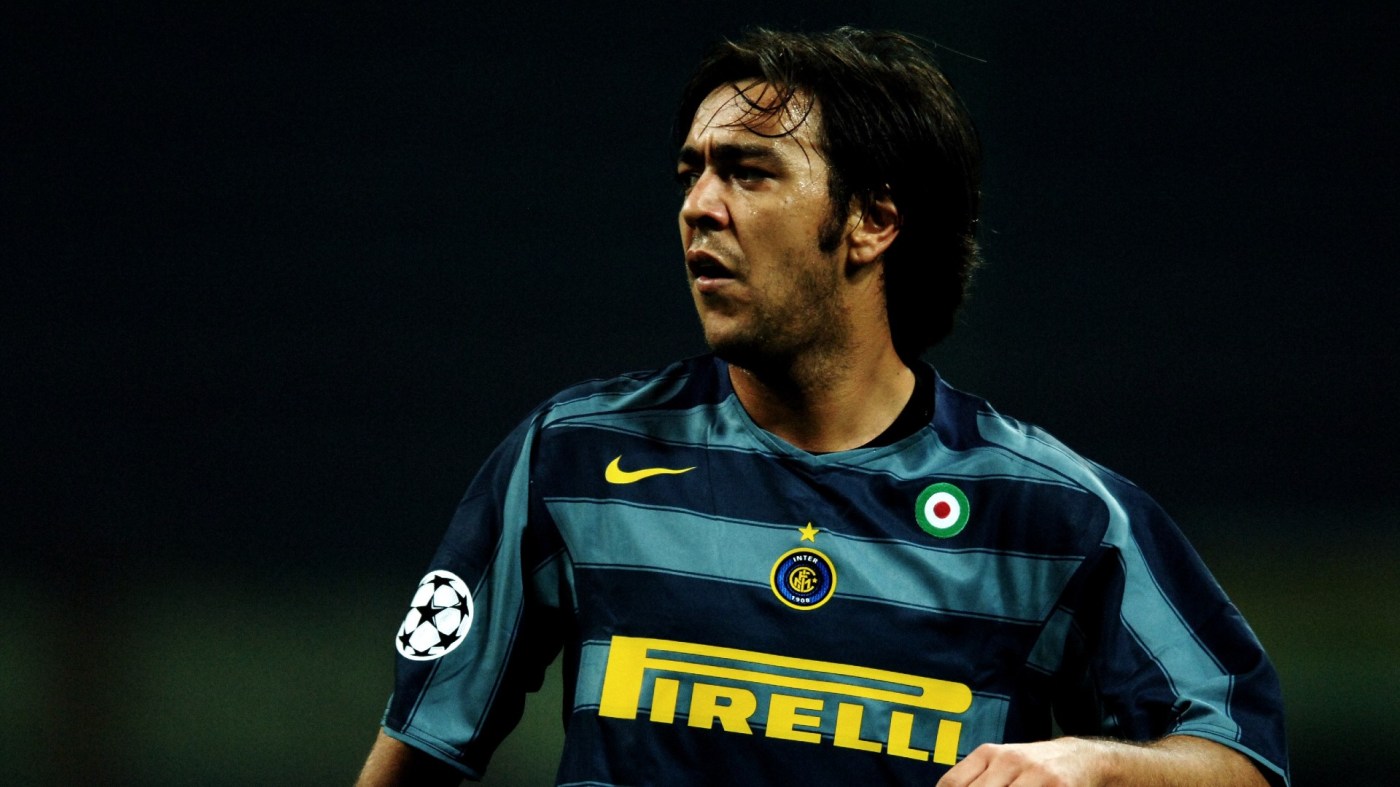
Álvaro Recoba did not need much space to change the temperature of a match. A loose ball near the corner of the box, a free-kick too far out for most players, a goalkeeper standing half a step off his line — that was enough. His left foot seemed to see routes that others did not. It bent shots around walls, cut passes through bodies, lifted crosses into blind zones and turned low-percentage moments into memories.
Recoba was never the most consistent genius of his era, nor the easiest player to build around. That is partly why he remains so compelling. He belonged to that rare category of footballer whose talent felt almost too large for the career that contained it: elegant, unpredictable, occasionally frustrating, but capable of producing moments that made supporters forget everything else.
Playing Style
Recoba was a fantasista in the broadest sense: part second striker, part attacking midfielder, part wide forward, and always a player searching for the unusual solution. He was not explosive in the Ronaldo sense, nor relentlessly industrious like the modern pressing forward. His game lived in timing, disguise and the violence of a left foot that could pass, shoot, cross and improvise from almost anywhere.
Technically, he was outrageous. His close control allowed him to glide inside from wide areas, while his balance gave him time to delay, shape his body, and choose whether to release a reverse pass or strike early. He could whip free-kicks with curl, drive long-range shots with power, and clip balls into the area with the softness of a playmaker rather than the mechanics of a winger.
Tactically, he was harder to define. At his best, Recoba played between zones: receiving between midfield and defence, drifting wide to open passing angles, then arriving centrally to finish. But that same freedom made him difficult for managers operating in Serie A’s rigid late-1990s and early-2000s tactical culture. His defensive work rate, injuries and inconsistency meant he was rarely a guaranteed structural piece. He was more spark than system, more possibility than control.
That, of course, was why fans loved him.
Rise to Fame
Recoba emerged in Uruguay with Danubio before moving to Nacional, where his left foot quickly outgrew domestic football. By 1997, Inter Milan had seen enough. He arrived in Italy at a time when Serie A was football’s grand theatre: tactically brutal, technically elite and filled with stars.
His Inter debut became instant mythology. On 31 August 1997, the same day Ronaldo made his league debut for the club, Inter were trailing Brescia at San Siro. Recoba came on and scored twice in the final minutes: first a thunderous long-range strike, then a curling free-kick. Inter won 2-1, and the new Uruguayan had somehow stolen the spotlight from the most exciting footballer on earth.
It was a perfect introduction because it contained the whole Recoba story: impossible technique, dramatic timing, and a sense that normal football logic did not apply when the ball sat on his left foot.
Peak Period / Standout Years
Recoba’s strongest Inter period came around the turn of the millennium and into the early 2000s, when he became a decisive, if still irregular, attacking weapon. His 1998-99 loan spell at Venezia was especially important in shaping his reputation. Given regular responsibility, he became the side’s creative centre, scoring and assisting at a level that helped drag the club away from relegation danger.
Back at Inter, he produced his best league scoring seasons in patches rather than long uninterrupted runs. Across all competitions for Inter, he finished with 261 appearances and 72 goals, including 53 goals in 176 domestic league appearances. Those numbers are strong, but they do not fully explain him. Recoba was not remembered because he steadily accumulated goals. He was remembered because so many of them felt like events.
He could be peripheral for long spells, then decide a match with one touch. A free-kick from distance. A shot from an absurd angle. A pass that removed an entire back line. His rhythm was not always reliable, but his ceiling was intoxicating.
Inter Milan and the Cult Hero Paradox
Recoba’s Inter career is one of the great cult hero contradictions. He was adored, protected and romanticised by supporters, yet he never quite became the undisputed centre of the team. That was not simply a failure of talent. Inter were overloaded with attacking names across his era: Ronaldo, Christian Vieri, Roberto Baggio, Adriano, Hernán Crespo, Zlatan Ibrahimović and others all passed through or shared parts of the same attacking landscape.
Managers changed. Systems changed. Expectations changed. Recoba remained Recoba: brilliant enough to survive every debate, inconsistent enough to keep the debate alive.
Massimo Moratti’s affection for him says plenty. The former Inter president later described Recoba as “everything I love about football,” while also calling him “talented, surprising, brilliant, and fun.” It is hard to find a better summary. Recoba was not the ideal modern forward. He was something more romantic: a player who carried the possibility of beauty even when the match itself was ordinary.
Uruguay and International Career
For Uruguay, Recoba was one of the gifted bridge figures between eras: after Enzo Francescoli, before the rise of Diego Forlán, Luis Suárez and Edinson Cavani. He won 69 caps and scored 11 goals for his country, representing Uruguay at the 2002 World Cup and at Copa América tournaments.
His international career added to his aura because Uruguay has always valued players who combine technique with emotional weight. Recoba was not merely a forward; he was a creative burden-bearer, the left-footed player expected to make something happen when Uruguay needed invention.
At the 2002 World Cup, he scored in the dramatic 3-3 draw with Senegal, a match that captured both Uruguay’s fight and frustration. Like much of Recoba’s career, it was a glimpse of what could happen when talent met urgency.
Cult Legend Status
Recoba is a cult legend because his career resists neat measurement. He won major trophies with Inter, including the UEFA Cup, Serie A, Coppa Italia and Supercoppa Italiana. He later returned home and won league titles with Nacional. But the emotional pull of Recoba is not primarily statistical.
It is aesthetic.
Fans remember the body shape before a free-kick. The left-footed strike that seemed to start outside the post and finish inside the top corner. The lazy elegance that could look indifferent one moment and devastating the next. His nickname, El Chino, became attached to a player who felt both familiar and unknowable.
He did not maximise every ounce of his talent in the way football culture often demands. But perhaps that is why he endures. Recoba’s appeal lies in the gap between what he was and what he might have been. He gave supporters enough genius to dream, and enough mystery to keep discussing him decades later.
End of Career
After leaving Inter, Recoba had spells with Torino and Panionios before returning to Uruguay with Danubio and then Nacional. His late career felt fittingly romantic: the wandering genius back home, still capable of producing touches and goals that reminded everyone why he had once lit up San Siro.
He retired after a career that had stretched from Montevideo to Milan, from Serie A glamour to the emotional pull of Nacional. He left not as a universally ranked great, but as something more personal to those who watched him: a footballer people felt they had discovered, defended and remembered.
Legacy
Álvaro Recoba represents a kind of football that feels increasingly rare. He was not built for spreadsheets, pressing maps or tactical obedience. He was built for the gasp before the ball hit the net. He was built for the moment when a supporter sees a player try something unreasonable and, for one second, believes it might actually work.
His legacy is not that he became the greatest player of his generation. He did not. His legacy is that his best moments still feel untouched by time. Recoba made football feel less predictable, less mechanical, more imaginative. He was beauty with flaws, genius with interruptions, magic with a left foot.
And for a Cult Legend, that may be the purest legacy of all.
Key Statistics and Achievements
International Career
- Uruguay: 68 caps, 10 goals
- Represented Uruguay at the 2002 World Cup
- Played at the 1997 Copa América and 2007 Copa América
- Scored for Uruguay at the 2002 World Cup against Senegal
- Remembered as one of Uruguay’s most gifted attacking players of his generation
Inter Milan
- UEFA Cup winner: 1997/98
- 2 Serie A titles: 2005/06, 2006/07
- 2 Coppa Italia titles: 2004/05, 2005/06
- 2 Supercoppa Italiana titles: 2005, 2006
- Became a cult hero at Inter for his spectacular left foot, long-range shooting, free-kicks and unpredictable moments of genius
- Spent more than a decade connected to Inter, including his loan spell at Venezia
Venezia Loan Spell
- Joined Venezia on loan during the 1998/99 season
- Produced one of Serie A’s great short-term loan spells, helping the club avoid relegation
- Remembered for spectacular goals, decisive performances and carrying a struggling side with moments of individual quality
Nacional and Uruguay Legacy
- Returned to Uruguay later in his career with Nacional
- Uruguayan champion with Nacional
- Ended his playing career back in Uruguay, reinforcing his connection with Nacional and Uruguayan football
- Also represented Danubio, where his professional career began
Individual Legacy
- Widely remembered as one of football’s great “what if” talents
- Celebrated for his left foot, vision, free-kicks, long-range shooting and ability to create something from nothing
- Became one of Inter’s most beloved cult figures despite never fully becoming a week-to-week superstar
- His career remains a classic example of genius, inconsistency and unforgettable moments living side by side
Sources / References
- Inter Milan official archive – Background on Recoba’s Inter career, including appearances, goals, club honours and his long association with the Nerazzurri.
- Transfermarkt – Supporting reference for full career timeline, positions, club spells, honours and tournament participation across Inter, Venezia, Nacional, Danubio, Panionios and Uruguay.
- National Football Teams – Used for Uruguay caps, goals and international career record.
- RSSSF international appearances archive – Supporting reference for Recoba’s Uruguay appearances and match-by-match international involvement.
- FIFA World Cup archive – Reference for Recoba’s participation at the 2002 World Cup and his goal against Senegal.


Leave a Reply