
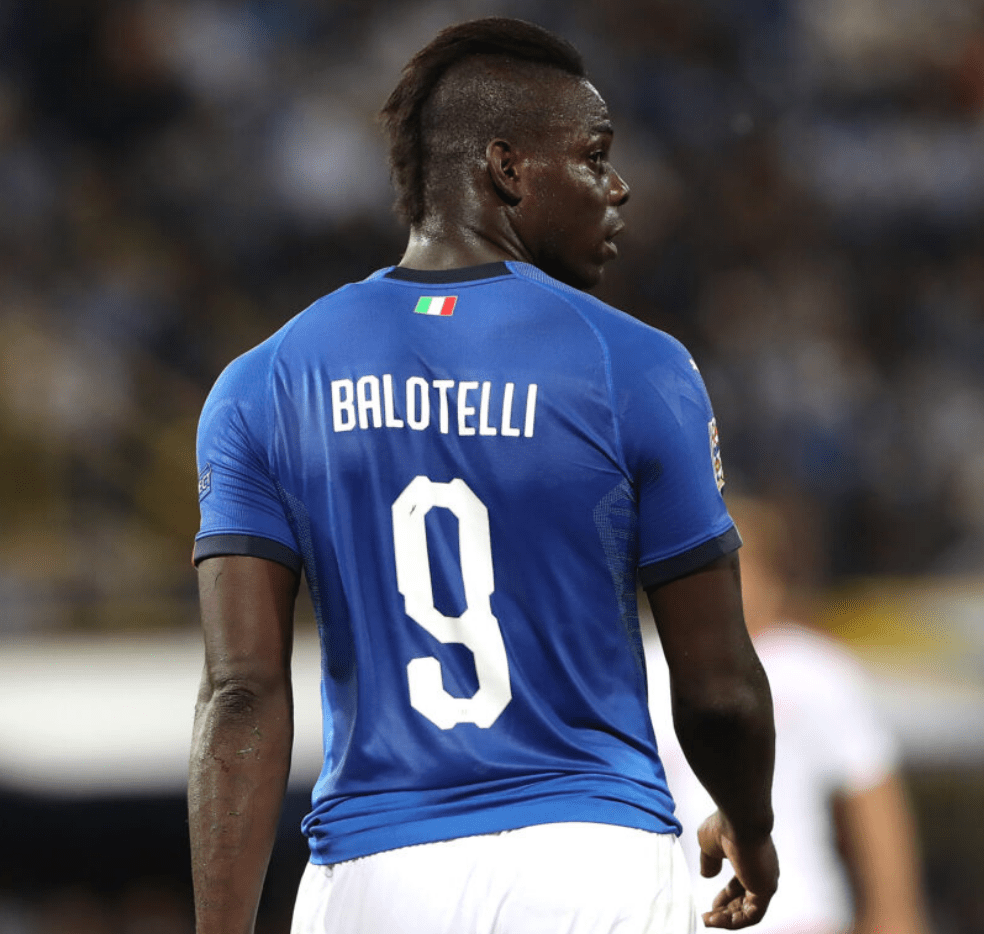
Mario Balotelli always seemed to play football as if the normal rules did not quite apply to him. Not tactically, not emotionally, not narratively. He could be walking through a match, barely involved, almost detached from the rhythm around him, and then produce something so clean and destructive that it made the previous hour feel irrelevant.
That was the strange power of Balotelli. He did not always look engaged, but he always looked dangerous. A penalty was almost a formality. A shot from distance felt possible from anywhere. A centre-back could dominate him for 80 minutes and still leave the pitch remembering the one moment where Balotelli made him look ordinary.
His career was not empty. He won league titles in Italy and England, lifted the Champions League with Inter, scored in major tournaments for Italy and produced one of the Premier League’s most famous assists.
Yet somehow, the feeling remains that football only saw flashes of what he could have been.
The Beginning
Balotelli’s rise began at Lumezzane, but it was at Inter Milan where the noise around him became impossible to ignore. He was still a teenager when he broke into one of Europe’s biggest clubs, playing in a squad filled with senior winners and managed, eventually, by José Mourinho.
The raw materials were obvious. Balotelli was powerful, quick enough, technically gifted, two-footed enough to be unpredictable, and unusually composed in front of goal for someone so young. He had the frame of a centre-forward, the confidence of a street footballer and the striking technique of someone who believed every shot was worth taking.
He was not just another promising academy player. He was seen as a potential superstar. In 2010, he won the Golden Boy award, given to Europe’s best young footballer. That put him into a category reserved for players expected to shape the next decade, not simply contribute to it.
Why Expectations Were So High
The expectations around Balotelli were not invented by fans or media hype alone. Managers who worked with him understood the scale of his talent, even when they were frustrated by everything around it.
Roberto Mancini, who managed him at Inter and Manchester City, repeatedly spoke about him as a player with elite potential. In 2012, Mancini said Balotelli “has everything to be one of the best players in the world,” while also warning that talent alone would not be enough. At another point, he suggested Balotelli could reach the level just below the very greatest names if he learned to apply himself consistently.
That was always the question. Balotelli had the body, the touch, the finishing, the self-belief and the big-game temperament. What he did not always have was the rhythm of a professional career: the week-to-week discipline, the tactical obedience, the emotional steadiness, the ability to turn potential into routine.
And yet, for a while, it still felt like it might come together.
The Peak
Balotelli’s peak was not one season. It was a collection of moments that seemed to suggest the same thing: when the stage was big enough, Mario could rise to it.
At Manchester City, he helped change the club’s modern history. He scored in the 2011 FA Cup final win over Stoke, a victory that gave City their first major trophy for 35 years. A year later, in the final seconds of the 2011/12 Premier League season, he slid the ball into Sergio Agüero’s path for the goal that won City the title. It was his only Premier League assist, which somehow made it even more Balotelli.
Then came Euro 2012.
Against Germany in the semi-final, Balotelli produced the performance that should have become the foundation of something greater. His first goal was classic centre-forward movement, attacking the space and heading Italy ahead. His second was pure violence: a run beyond the defence, a touch to set himself, and a finish smashed high past Manuel Neuer.
The celebration became iconic. Shirt off, muscles tense, expression cold. For one night, Balotelli did not look like a question. He looked like the answer.
The Demise
The frustrating part is that the decline was not immediate. After leaving Manchester City, Balotelli returned to Italy and started brilliantly at AC Milan. He scored regularly and looked, briefly, like a player restored by home, responsibility and trust.
But the pattern returned. Strong starts became followed by noise, inconsistency, tactical issues and moves that never quite settled. Liverpool was meant to be a reset after Luis Suárez left, but it exposed the limitations in Balotelli’s game at that point. Brendan Rodgers later admitted it was difficult to connect with him, even while acknowledging his talent and tools.
Balotelli himself later accepted some responsibility for that period, while also arguing that the tactical set-up at Liverpool did not suit his characteristics. Both things can be true. He was not always managed perfectly, but he also did not consistently do enough to force the game to adapt around him.
From there, the career became a tour of restarts: Milan again, Nice, Marseille, Brescia, Monza, Turkey, Switzerland and beyond. There were goals, especially at Nice, where he reminded everyone that the finishing gift had not disappeared. But the idea of Balotelli as a Ballon d’Or-level forward had gone.
Why It Was So Unfortunate
Balotelli’s story is unfortunate because football rarely produces players with that combination of physical power, technical ease and theatrical gravity. He had the qualities to be a modern No.9 before the role became so demanding: strong enough to play through contact, clean enough to combine, ruthless enough to finish, confident enough to decide big matches.
Italy could have built around him. City could have had a long-term cult hero who became more than a cult hero. Milan could have had a star to carry them through a difficult era.
Instead, Balotelli became a player people argued about more than they consistently watched at his best.
Legacy
It would be wrong to call Balotelli a failure. Most players would trade careers with him instantly. He has trophies, famous goals, international moments and a place in football culture that will outlive many more consistent professionals.
But this series is about the gap between achievement and possibility.
With Balotelli, that gap still feels huge. He was not simply a talented player who lost his way. He was a player who, for brief spells, made greatness look almost casual. That was the gift and the tragedy. Football kept waiting for Mario Balotelli to become inevitable.
He only ever became unforgettable.
Sources
The Guardian – Roberto Mancini warns Mario Balotelli that time is running out to fulfil his potential
https://www.theguardian.com/football/2012/nov/20/mario-balotelli-roberto-mancini-work-harder
The Guardian – Manchester City’s Mario Balotelli told to start playing with a smile
https://www.theguardian.com/football/2010/dec/23/manchester-city-mario-balotelli-play-smile
The Guardian – Roberto Mancini “so sad” over Mario Balotelli’s Manchester City exit
https://www.theguardian.com/football/2013/jan/29/roberto-mancini-mario-balotelli-manchester-city
UEFA – Germany 1-2 Italy, Euro 2012 semi-final match report
https://www.uefa.com/uefaeuro/match/2003379–germany-vs-italy/
UEFA – Milan bring Balotelli back to San Siro
https://www.uefa.com/uefachampionsleague/news/0205-0ea575b0ea09-900af74ad969-1000–milan-bring-balotelli-back-to-san-siro/
Premier League – Mario Balotelli official Premier League profile and statistics
https://www.premierleague.com/en/players/42493/mario-balotelli/overview
ESPN – Brendan Rodgers found it difficult to connect with Mario Balotelli at Liverpool
https://www.espn.co.uk/football/story/_/id/37500983/brendan-rodgers-found-difficult-connect-mario-balotelli-liverpool
Golden Boy Award – Mario Balotelli, 2010 Golden Boy winner
https://www.goldenboyaward.com/winner/mario-balotelli
Reuters – Balotelli back in Serie A after signing for Genoa
https://www.reuters.com/sports/soccer/balotelli-back-serie-after-signing-genoa-2024-10-28/


Leave a Reply