
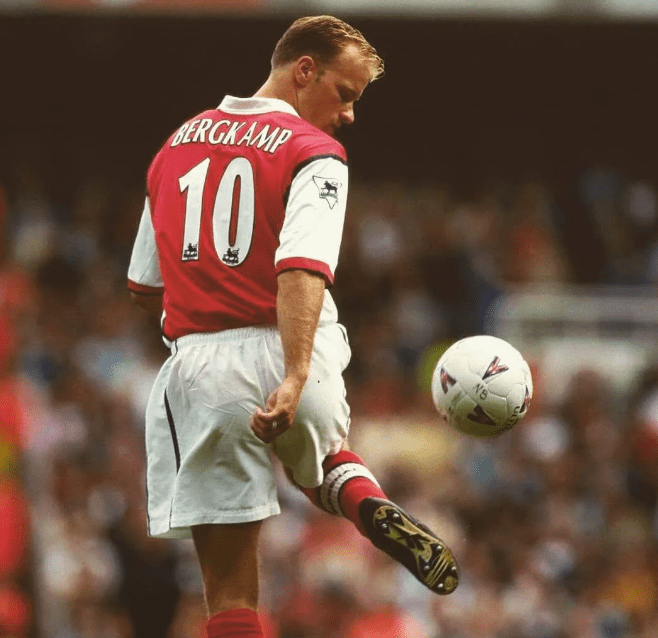
Dennis Bergkamp did not play football in a hurry. That was part of the spell.
While defenders rushed, midfielders pressed and matches tilted into chaos, Bergkamp seemed to exist in a calmer dimension. The ball would arrive at awkward height, awkward speed, under awkward pressure — and he would soften it, turn away, and reveal an option nobody else had seen. He was not the quickest forward, not the most aggressive, not the loudest personality in the room. But few players have ever made football look more controlled.
For Arsenal supporters, Bergkamp was more than a great player. He was a turning point. He arrived in 1995, before Arsène Wenger, before the Invincibles, before Arsenal became synonymous with technical fluency and attacking elegance. By the time he left in 2006, he had helped redefine the club’s identity.
The nickname was perfect: the Iceman. Not because he was emotionless, but because his football carried a rare calm. His genius was not explosive in the traditional sense. It was precise, calculated and devastatingly elegant.
Playing Style
Bergkamp was often listed as a forward, but that barely explains what he actually did. He was not a conventional striker, nor a pure No. 10. He operated in the space between both roles: dropping off the front line, receiving between midfield and defence, linking play, creating chances and arriving in scoring positions with immaculate timing.
His first touch was his signature. Many players use their first touch to control the ball. Bergkamp used his to control the next three seconds of the match. He could kill the ball dead, shift it away from pressure, open his body for a pass, or take a defender out of the game before they realised the duel had begun.
Technically, he was near-perfect: clean striking, disguised passing, intelligent movement, subtle body shape and extraordinary balance. He was also stronger than his elegant style suggested. Bergkamp could receive with his back to goal, hold off centre-backs, and bring runners into play. But his greatest weapon was thought. He saw pictures earlier than others and had the technique to act on them.
At Arsenal, this made him the ideal partner for quicker, more direct forwards. Ian Wright benefited from his supply, Nicolas Anelka from his timing, and Thierry Henry from his imagination. Henry brought devastating speed and finishing; Bergkamp gave Arsenal the pause, the pass and the platform.
Rise to Fame
Bergkamp’s football education came through Ajax, where technical intelligence was not optional. He emerged from one of Europe’s great development environments and became part of a club culture built on positional understanding, passing detail and tactical education.
At Ajax, he was prolific and refined, winning domestic honours and the UEFA Cup in 1992. He then moved to Inter Milan in 1993, but Italy proved a difficult fit. Serie A at the time was brutally defensive, tactically rigid and unforgiving for foreign attackers who needed freedom. Bergkamp won the UEFA Cup with Inter in 1994, but his time there never fully captured his talent.
When Arsenal signed him in 1995, it was a landmark deal. English football was still transitioning into the modern Premier League era, and Arsenal were not yet the sleek technical machine they would become under Wenger. Bergkamp’s arrival felt different. He gave Arsenal sophistication before the full revolution had even begun.
Arsenal Peak
Bergkamp’s best Arsenal years were about more than goals. The Premier League officially records him with 315 appearances, 87 goals and 94 assists — numbers that show his dual role as scorer and creator. But even those statistics undersell his influence.
The 1997–98 season was a defining campaign. Arsenal won the Premier League and FA Cup double, and Bergkamp was named PFA Players’ Player of the Year and FWA Footballer of the Year. That season, he was arguably the most complete attacking player in England: scoring, assisting, dictating tempo and producing moments of outrageous invention.
His hat-trick against Leicester City in 1997 remains one of the Premier League’s great individual displays. One of those goals, where he brought down a long pass, manipulated the ball between defenders and finished with impossible calm, captured the essence of Bergkamp. It was not just technique. It was geometry.
Then came Newcastle in 2002.
The goal against Newcastle is still debated because it looked almost too perfect to be real. Bergkamp received the ball with his back to goal, flicked it one way around Nikos Dabizas, spun the other way, and finished calmly. Whether instinctive, planned or somewhere between the two, it became one of the most iconic goals in Premier League history. It was Bergkamp in one movement: imagination, touch, balance, cruelty.
The Netherlands and the Argentina Goal
For the Netherlands, Bergkamp’s legacy was sealed at the 1998 World Cup.
In the quarter-final against Argentina, with the match heading towards extra time, Frank de Boer launched a long diagonal pass from deep. Bergkamp controlled it out of the sky with his first touch, nudged it past Roberto Ayala with his second, and finished with the outside of his foot with his third. It was a goal of outrageous difficulty made to look clean and inevitable.
That moment belongs among the greatest World Cup goals ever scored. It was not a solo run or a thunderbolt. It was something more Bergkamp: three touches of absolute clarity under maximum pressure.
The goal also summed up why he was different. Plenty of players could score spectacularly. Very few could turn a long pass, a world-class defender and a World Cup quarter-final into a moment of silence and control.
Cult Legend Status
Bergkamp’s cult status is unusual because he was not underrated. He was widely admired, decorated and respected. But cult legends are not only players who slipped through the cracks. Sometimes they are players whose style creates a deeper emotional attachment.
Bergkamp gave supporters memories that feel almost tactile: the first touch, the swivel, the disguised pass, the chipped finish, the calm celebration. He was not a player of endless noise. He was a player of moments that people replay in their minds years later.
He also helped change Arsenal’s footballing language. Before Wenger’s Arsenal became associated with beauty, speed and combination play, Bergkamp was already pointing the club in that direction. He made technical excellence feel central to Arsenal’s identity.
For younger Arsenal fans, Thierry Henry may be the ultimate icon of the Wenger era. But Bergkamp was the architect in the shadows. Henry stretched the pitch. Bergkamp explained it.
End of Career and Legacy
Bergkamp retired in 2006 after Arsenal’s move from Highbury to the Emirates era had begun. By then, he had won three Premier League titles and four FA Cups with the club, including the unbeaten 2003–04 Invincibles season. His testimonial was the first match played at the Emirates Stadium, a fitting bridge between Arsenal’s old home and its modern future.
His legacy has only grown. In an age where attackers are often judged by pressing numbers, output charts and tactical versatility, Bergkamp remains a reminder that football intelligence is still one of the game’s rarest gifts. He was not just a scorer or creator. He was a problem-solver.
Every great team needs players who accelerate the game. Bergkamp’s genius was that he slowed it down — and somehow made everyone else arrive at exactly the right time.
Key Statistics and Achievements
International Career
- Netherlands: 79 caps, 37 goals
- Represented the Netherlands at the 1994 World Cup, Euro 1996, 1998 World Cup and Euro 2000
- Scored one of the most iconic World Cup goals against Argentina in 1998
- Retired as the Netherlands’ all-time leading goalscorer at the time
Arsenal
- 423 appearances, 120 goals
- Premier League record: 315 appearances, 87 goals, 94 assists
- 3 Premier League titles: 1997/98, 2001/02, 2003/04
- 4 FA Cups: 1997/98, 2001/02, 2002/03, 2004/05
- Part of Arsenal’s unbeaten Invincibles squad in 2003/04
- First testimonial played at the Emirates Stadium in 2006
Ajax
- Eredivisie winner: 1989/90
- KNVB Cup winner: 1986/87, 1992/93
- UEFA Cup winner: 1991/92
- Developed through Ajax’s academy and became one of Europe’s outstanding young forwards
Inter Milan
- UEFA Cup winner: 1993/94
- Scored 8 goals during Inter’s successful UEFA Cup campaign
- Later rebuilt his career and legacy after moving to Arsenal in 1995
Individual Legacy
- PFA Players’ Player of the Year: 1997/98
- FWA Footballer of the Year: 1997/98
- Inducted into the Premier League Hall of Fame
- Regularly cited as one of Arsenal’s greatest ever players
- Remembered for his first touch, vision, composure and role in reshaping Arsenal’s attacking identity
Sources / References
- Arsenal official profile – Background on Bergkamp’s Arsenal career, club legacy, major honours, total appearances/goals, and his importance in shaping the Wenger-era identity.
- Premier League official profile – Used for Premier League appearances, goals, assists, Hall of Fame recognition, and individual league records.
- FIFA World Cup archive – Reference for Bergkamp’s Netherlands career and the iconic 1998 World Cup goal against Argentina.
- UEFA archives – Supporting reference for his European career, including Ajax’s 1991/92 UEFA Cup win and Inter Milan’s 1993/94 UEFA Cup triumph.
- Transfermarkt – Supporting reference for full career timeline, positions, appearances, goals and honours across Ajax, Inter Milan, Arsenal and the Netherlands.


Leave a Reply