
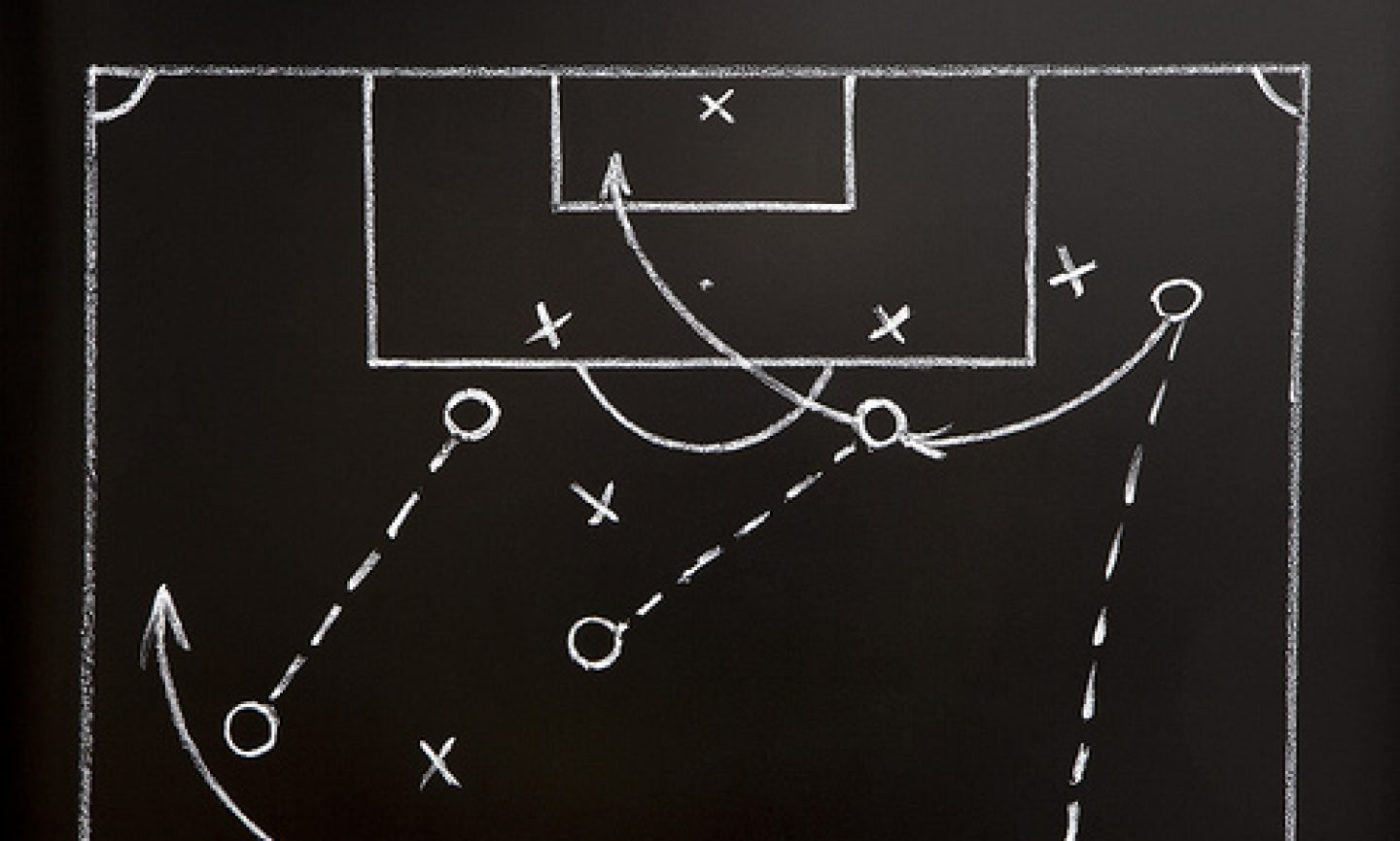
The 4-5-1 has never been football’s most fashionable formation. It does not carry the attacking glamour of a 4-3-3, the modern buzz of a 3-2-4-1, or the tactical intrigue of a back-three system with wing-backs flying forward. Yet few shapes have survived football’s evolution as stubbornly as the 4-5-1.
In a game increasingly defined by pressing, rotations, inverted full-backs, box midfields and positional play, the 4-5-1 still matters because it solves one of football’s oldest problems: how to protect central space without surrendering the entire pitch.
At its simplest, the shape uses a back four, a midfield five and one centre-forward as the highest player. Coaches’ Voice describes it as similar to a 4-3-3, but with the wide players positioned deeper and closer to the central midfield trio. The midfield line also tends to be flatter than in a 4-3-3, with the deepest midfielder sitting closer to the two No.8s rather than operating as a clearly separated single pivot. That flatter second line of five is the system’s identity: it gives a team compactness, width coverage and a strong screen in front of the back four.
That is why the 4-5-1 remains so useful out of possession. FIFA’s 2022 World Cup technical analysis highlighted the importance of mid-block defending and compactness, noting that elite teams increasingly showed an ability to control games without dominating the ball. FIFA defines a mid-block as a collective defensive phase in the middle, or middle and defensive third, with the aim of staying compact, denying central channels and forcing opponents wide or backwards. The 4-5-1 is naturally built for that task.
The lone striker is crucial. He is not simply waiting for service. His first job is often to shape the opponent’s build-up. Coaches’ Voice notes that the centre-forward can press centre-backs to force play one way, usually towards the touchline, or drop deeper to screen access into the opposition pivot. In one version, he is the first presser. In another, he is the first blocker. Either way, he gives the midfield five time to organise behind him.
Behind him, the three central midfielders protect the middle. They can defend as a flat trio, apply pressure to opposition midfielders, or create a zonal screen in front of the centre-backs. The wide midfielders complete the structure. Their job is demanding: they must help the full-backs, track opposition wide players, block crosses and cut-backs, and still be ready to break forward when the ball is won. Coaches’ Voice makes the point that the wide midfielders can defend wider because the central trio protects inside, helping the team force the ball towards the touchline and use the sideline as an extra defender.
This is the 4-5-1 at its best: compact centrally, secure out wide, and difficult to play through.
The system also suits tournament football. International managers have limited time to coach complex automatisms, so they often rely on structures that provide clarity. A 4-5-1 tells players where to stand, when to shift, who protects the centre and where the pressing trap begins. It may not dominate possession, but it can dominate the opponent’s options.
Modern control is no longer purely about having the ball. FIFA’s 2022 World Cup analysis showed that compact mid-blocks were one of the defining tactical themes of the tournament. The best teams demonstrated that control without possession can be just as important as control with it. For teams facing technically superior opponents, the 4-5-1 can turn a match into a test of patience, spacing and decision-making.
The attacking side of the 4-5-1 is also underrated. It is not usually a formation designed to monopolise possession, but it is well built for transition. Once the ball is regained, the wide midfielders can attack the channels, the No.8s can make forward runs inside them, and the lone centre-forward can hold the ball, spin behind or bring runners into play.
Coaches’ Voice identifies the centre-forward’s hold-up play as a key in-possession responsibility. He must secure the first pass forward and allow teammates to connect around him, particularly the No.8s and wide midfielders making transition runs. This is where the formation becomes more flexible than it looks. In possession, it can become a 4-1-4-1, a 4-3-3 or a 4-2-3-1. One No.8 can drop towards the ball. A wide midfielder can push high. A full-back can advance or move inside. The 4-5-1 is a defensive base, not a tactical prison.
FIFA’s analysis of the modern No.9 supports this. At the 2022 World Cup, offers in behind by No.9s increased by 10.53% compared with 2018, rising from 23.94 per 90 minutes to 26.46 per 90. FIFA also noted that centre-forwards became more efficient, scoring more despite fewer attempts. That trend suits the 4-5-1. The lone striker is no longer just an isolated target. He is a depth threat, pressing reference, hold-up outlet and penalty-box finisher.
Jürgen Klopp’s Liverpool are a useful example of the system’s defensive flexibility. They are associated with aggressive counter-pressing and attacking intensity, but Coaches’ Voice notes that Klopp has used a 4-5-1 when a more compact block is required. In that shape, the No.8s could still jump out to press, while the wide players — particularly Mohamed Salah — remained key transition outlets. The formation did not remove Liverpool’s attacking threat; it simply gave them a more compact defensive platform.
Bayern Munich under Carlo Ancelotti in 2016/17 offer a stronger attacking example. Although Bayern were often listed in 4-3-3 or 4-2-3-1 variations, their structure regularly carried 4-1-4-1 or 4-5-1 principles: Robert Lewandowski as the lone centre-forward, Thiago or Xabi Alonso controlling the base, and wide players such as Arjen Robben, Franck Ribéry, Douglas Costa and Kingsley Coman stretching the pitch.
The key was width. Bayern’s midfield security allowed the wingers to stay high and wide before attacking inside, while Philipp Lahm and David Alaba supported from full-back. UEFA’s 2016/17 Champions League technical report highlighted Bayern’s flank relationships, noting that Lahm made 18 passes to Robben in one analysed match, while Alaba supplied 15 passes to Ribéry on the opposite side. That passing pattern showed how Bayern used a compact midfield base to create repeated wide combinations rather than simply funnel everything through the centre.
This is where the 4-5-1 becomes more than a defensive shell. With three central midfielders protecting behind the ball, the wide players can receive early, isolate full-backs and combine with overlapping support. Robben and Ribéry were not traditional defensive wide midfielders in style, but within this structure they could still drop into the midfield line before springing forward into 1v1 situations. Lewandowski then gave Bayern a penalty-box reference for crosses, cut-backs and second balls.
That balance between compactness and attacking width is vital. The 4-5-1 does not have to be passive. It can start in a mid-block and then jump when the ball is forced wide, played backwards or received under pressure. The striker directs the ball, the nearest No.8 supports the jump, the wide midfielder presses the full-back, and the touchline closes the trap. Done well, the opponent is not just being contained; they are being guided into a zone where possession becomes uncomfortable.
Opta’s recent Premier League analysis adds useful context. Their 2024/25 playing-style data showed that high turnovers are not all equal. Bournemouth had fewer high turnovers than Manchester City, but produced 21 more shots from those situations; 20.8% of their high turnovers ended in a shot, an efficiency bettered only by Nottingham Forest and Liverpool. The lesson is that pressing value is not simply about how often a team wins the ball high, but how efficiently those regains become chances. A 4-5-1 can support that logic because its compactness creates controlled pressing traps rather than reckless pressure.
The 4-5-1 is not without weaknesses. Its biggest risk is isolation. If the midfield line drops too deep, the centre-forward becomes disconnected. If the wide midfielders spend too long defending near their own box, the team loses its transition outlets. If the central midfielders cannot receive and pass under pressure, every regain becomes a clearance. Coaches’ Voice also notes that the flatness of the midfield unit can make it harder to dominate the ball, because the team may need to reorganise into different lines to play through the pitch.
That is the difference between a good 4-5-1 and a bad one. A poor 4-5-1 becomes survival football: nine players behind the ball, one forward chasing lost causes, and no clear route out. A good 4-5-1 is controlled resistance. It protects the middle, forces the opponent wide, creates pressing traps, and releases runners quickly when possession is won.
Euro 2024 again showed how valuable central protection remains. In the final, UEFA’s technical report noted that England defended well in the first half and limited Spain to only five shots worth 0.29 expected goals. Spain eventually solved the problem after half-time by adjusting from a 1+2 midfield to a 2+1, with Fabián Ruiz dropping alongside Martín Zubimendi and Dani Olmo finding more space in pockets. That example was not a pure 4-5-1, but the principle was familiar: compact midfield structures can disrupt even elite possession teams, forcing them to change the geometry of their build-up.
That is why the 4-5-1 still matters. Football keeps inventing new terminology for old requirements: compactness, rest defence, transition control, zone protection, pressing traps, central occupation. The 4-5-1 understood many of those ideas before they became fashionable.
It may not be the shape of domination. But football is not won by novelty. It is won by solving space, controlling risk and giving players clear roles in chaotic moments.
The 4-5-1 survives because it still solves problems. It protects the centre. It supports the full-backs. It gives the striker a clear defensive role. It creates transition routes for wide players and No.8s. It can morph into more expansive shapes with the ball. And in a game where elite teams are desperate to play through the middle, few formations are still better at closing the door.
The 4-5-1 is not dead. It has simply become what it always was at its best: a structure for teams who understand that control is not only about possession. Sometimes, control is about what you refuse to let the opponent do.
Data & Technical Sources Used
- Coaches’ Voice — The 4-5-1 formation: football tactics explained
- FIFA Training Centre — World Cup 2022 tactical analysis: mid-blocks and compactness
- FIFA Training Centre — World Cup 2022 analysis of the modern No.9
- UEFA — 2016/17 Champions League Technical Report
- UEFA — Euro 2024 Technical Report / final tactical analysis
- Opta Analyst — Premier League 2024/25 high-turnover and playing-style analysis


Leave a Reply