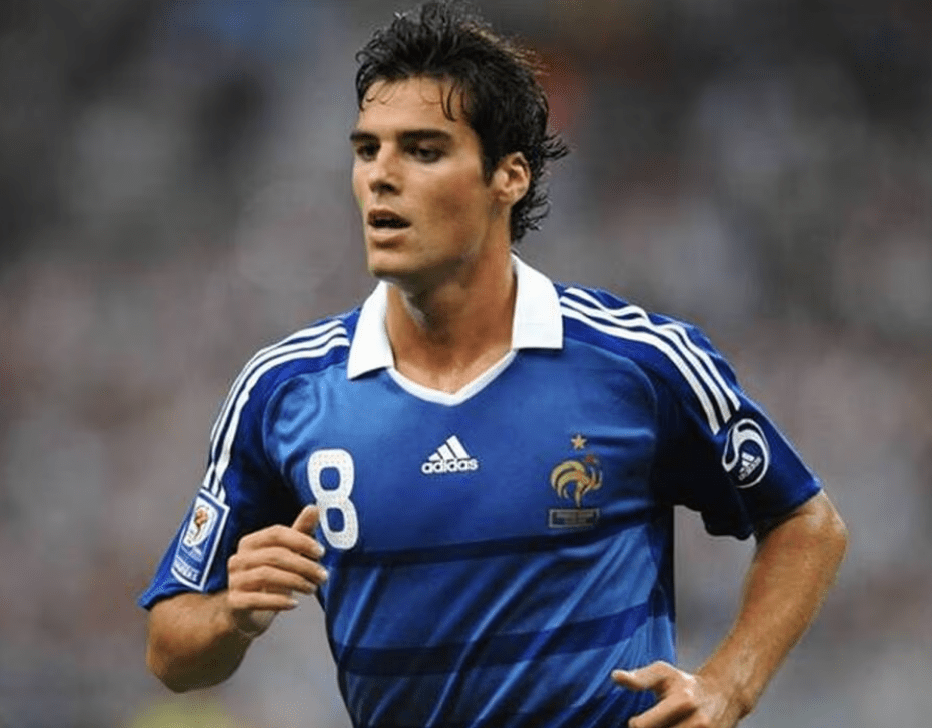
Yoann Gourcuff played football as though the game was supposed to be quieter than everyone else made it. In an era moving towards pressing, athleticism and tactical compression, he seemed to belong to an older language: first touch, disguise, pause, release.
At his best, Gourcuff did not rush matches. He slowed them down until defenders moved where he wanted them, then slipped away with that graceful upright stride, the ball almost protected rather than simply controlled. His gift was not chaos or explosiveness. It was elegance — the ability to make difficult football look natural.
That is why his story still holds such emotional weight. Gourcuff was not simply a player who failed to become what many predicted. He was a footballer whose peak was so beautiful, so technically pure and so brief that it became preserved in memory almost untouched.
Playing Style: A Number 10 in Brushstrokes
Gourcuff was primarily an attacking midfielder, most comfortable operating between the lines as a classic number 10. He could play deeper or drift from the left, but his natural home was the pocket behind the striker, where he could receive under pressure and change the rhythm of a match.
Technically, he was exceptional. His first touch often removed defenders before the duel had properly begun. He carried the ball with his head up, used subtle shifts of balance rather than raw pace, and possessed the passing range to combine short or switch play over distance. He also offered threat from set pieces and long-range shots.
Physically, he was more imposing than many creative midfielders. At around 1.85 metres, he had height and balance, yet moved with a lightness that made him instantly recognisable. When he received with his back to goal, he could shield, roll and turn in one smooth action.
His weaknesses were tied partly to the qualities that made him special. Gourcuff needed rhythm, trust and continuity. He was at his best when the team structure placed him at the centre of the game. At AC Milan, surrounded by established stars such as Kaká, Andrea Pirlo and Clarence Seedorf, he never truly settled. Later, injuries repeatedly interrupted the confidence and sharpness his football required.
Rise to Fame: Rennes, Milan and the Bordeaux Stage
Born in Ploemeur and raised in a football family — his father Christian Gourcuff was a respected coach — Yoann came through Rennes, one of France’s strongest talent nurseries. By the mid-2000s, he was already seen as one of the country’s most elegant young technicians. His role in France’s UEFA European Under-19 Championship success in 2005 helped build his reputation further.
In 2006, AC Milan signed him. It looked like a dream move, but the timing was difficult. Milan were still one of Europe’s great sides, packed with Champions League winners and elite midfielders. Gourcuff collected major honours, including the 2006/07 Champions League as part of Carlo Ancelotti’s squad, but regular minutes were hard to find.
His return to France in 2008, on loan to Bordeaux, changed everything. Laurent Blanc’s side were organised, ambitious and searching for a creative conductor. Gourcuff became that figure almost immediately. Bordeaux were trying to end Lyon’s long domestic dominance, and Gourcuff gave them imagination at the exact moment they needed it.
Peak Period: Bordeaux 2008/09
The 2008/09 season is the reason Gourcuff belongs in the Cult Legends series. It was the campaign where everything aligned: player, manager, system, club and moment.
Bordeaux won Ligue 1, ending Lyon’s run of seven consecutive league titles, and also lifted the Coupe de la Ligue. Gourcuff was not simply part of that success; he was its technical centrepiece. In Ligue 1, he made 37 appearances and scored 12 goals, combining ball progression, chance creation, set-piece quality and decisive finishing with the authority of a player suddenly operating at his highest level.
His individual recognition matched the eye test. Gourcuff was named Ligue 1 Player of the Year for 2008/09 and also won Goal of the Season for his unforgettable strike against Paris Saint-Germain in January 2009. That goal remains the defining image of his career: receiving with his back to goal, spinning away with a roulette, manipulating defenders with a flick and finishing with complete calm.
Asked to explain it afterwards, Gourcuff said: “I can’t really explain how I did it, I just tried to get free and didn’t hesitate to shoot. It was pure instinct.”
That quote captures him perfectly. Gourcuff’s best football felt instinctive rather than manufactured. For one season in Bordeaux colours, he was not merely promising. He was decisive, decorated and genuinely elite.
Cult Legend Status: Beauty, Fragility and the Weight of Comparison
Gourcuff is a cult legend because his legacy lives in tension. He was too brilliant at his peak to be dismissed as wasted talent, but too interrupted across his career to be remembered simply as a great. He belongs in that emotional middle ground where football fans place players they cannot quite let go of.
The Zidane comparisons were unavoidable and, in some ways, unfair. Gourcuff was French, elegant, tall, technically smooth and thriving at Bordeaux, the club where Zidane had also made his name. But comparisons can become cages. Gourcuff was not Zidane. Almost nobody is. He was his own player, and his career is easier to appreciate when separated from that impossible standard.
For Bordeaux supporters, he represents a golden moment. The 2008/09 team had structure, steel and personality, but Gourcuff gave it romance. For neutral fans, he became a symbol of underappreciated genius: the playmaker whose highlights still feel different from modern football’s usual rhythm.
Lyon, Injuries and the Slow Unravelling
In 2010, Gourcuff joined Lyon in a major move that should have confirmed him as France’s leading creative midfielder. Instead, it became the most frustrating chapter of his career.
Lyon were transitioning away from their era of domestic dominance, and Gourcuff arrived carrying huge expectation. There were flashes of class — clever touches, sharp combinations, occasional goals that reminded everyone of the talent beneath the injuries — but the rhythm never lasted.
Fitness problems became the defining issue. Ankle, groin and muscular injuries repeatedly broke his continuity. For a player so reliant on sharpness, confidence and repetition, those interruptions were damaging. This was not a player who stopped having ability. It was a player whose body repeatedly denied him the sequence of games he needed.
After Lyon, he returned to Rennes in 2015, where there were still moments of elegance but no full revival. His final professional stop came at Dijon in 2018/19, before his playing career quietly faded out.
Legacy: The Player Who Remains in the Imagination
Yoann Gourcuff’s legacy is not built on longevity. It is built on memory — the memory of a player who seemed to have more time than everyone else.
He represents a particular kind of football romanticism: the elegant number 10 whose best work needed rhythm, trust and freedom; the artist who could carry a team’s imagination; the player whose finest season still glows because it was never fully repeated. His career invites sadness, but it should not be remembered only with regret. Regret can flatten players into what they failed to become. Gourcuff deserves to be remembered for what he actually was.
At Bordeaux, he was magnificent. He helped turn a very good side into champions. He gave Ligue 1 one of its great modern individual seasons. He scored a goal against PSG that still feels like football choreography. He made supporters believe they were watching the next great French playmaker, and for a while, that belief felt completely reasonable.
That is why Gourcuff still matters. Not because he became Zidane, and not because his career followed the clean arc football expected. He matters because, at his peak, he reminded people that football could still be graceful. In the Cult Legends hall, Yoann Gourcuff stands as the underappreciated genius whose brightest spell was brief, beautiful and impossible to forget.Yoann Gourcuff — Key Statistics and Achievements
Statistics & Achievements
International Career
- France: 32 caps, 4 goals
- Represented France at the 2010 World Cup
- Played for France during the post-Zidane transition period
- Once viewed as a possible long-term creative successor to Zinedine Zidane
- Remembered as one of France’s most technically gifted midfielders of his generation
Rennes and Early Career
- Developed at Rennes, where he emerged as one of French football’s brightest young midfielders
- Built his reputation through elegant ball-carrying, passing range, shooting technique and creativity between the lines
- His early performances earned him a move to AC Milan in 2006
AC Milan
- UEFA Champions League winner: 2006/07
- UEFA Super Cup winner: 2007
- FIFA Club World Cup winner: 2007
- Shared a squad with elite midfielders including Kaká, Andrea Pirlo, Clarence Seedorf and Gennaro Gattuso
- Struggled for consistent minutes in a world-class Milan side, before rebuilding his career back in France
Bordeaux
- Ligue 1 winner: 2008/09
- Coupe de la Ligue winner: 2008/09
- Trophée des Champions winner: 2008, 2009
- Ligue 1 Player of the Year: 2008/09
- French Player of the Year: 2009
- Produced his career-best spell under Laurent Blanc, becoming the creative leader of one of Bordeaux’s greatest modern seasons
- His 2008/09 form briefly made him one of the most admired attacking midfielders in Europe
Lyon and Later Career
- Coupe de France winner: 2011/12
- Trophée des Champions winner: 2012
- Joined Lyon in a major move but struggled with injuries and consistency
- Later returned to Rennes before finishing his professional career with Dijon
- His later years became a story of technical brilliance repeatedly interrupted by physical setbacks
Individual Legacy
- Widely remembered as one of French football’s great “what could have been” talents
- Celebrated for his elegance, first touch, passing, long-range shooting and ability to glide through midfield
- His Bordeaux peak remains one of the clearest examples of his true level
Sources / References
- AC Milan official archive – Background on Gourcuff’s Milan spell, squad context and major European honours.
- Bordeaux / Ligue 1 official records – Reference for Bordeaux’s 2008/09 Ligue 1 title, Coupe de la Ligue win and Gourcuff’s individual peak.
- UNFP / France Football records – Used for Gourcuff’s Ligue 1 Player of the Year award and French Player of the Year recognition.
- French Football Federation records – Reference for France caps, goals and international tournament involvement.
- Transfermarkt – Supporting reference for full career timeline, club spells, positions, appearances, goals and honours across Rennes, AC Milan, Bordeaux, Lyon, Dijon and France.


Leave a Reply