
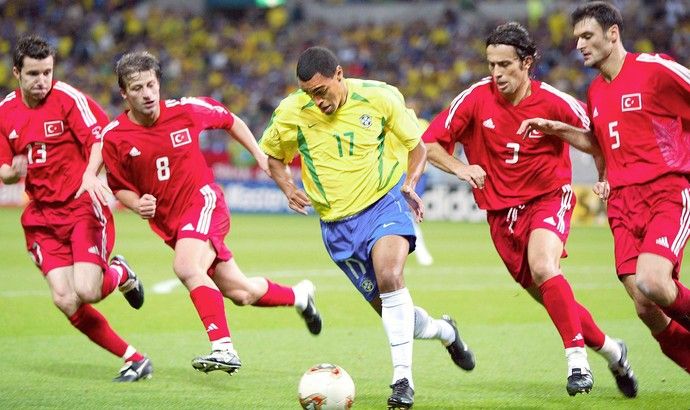
Denílson did not so much receive the ball as invite the match into his own private rhythm. Out on the left touchline, shirt bright yellow for Brazil or green and white for Real Betis, he would pause, roll his studs across the ball, drop a shoulder, then begin the dance: stepovers, feints, sudden stops, little accelerations that made defenders look as if they had been dragged from elite football into a street contest with rules they had not learned.
At his best, Denílson de Oliveira was pure Brazilian improvisation. He was not the most productive winger of his generation, nor the most complete. But he was one of its great entertainers: a player whose dribbling felt like spectacle, whose career mixed World Cup glory, impossible expectation, flashes of genius and the complicated weight of becoming the world’s most expensive footballer before he had fully become himself.
Playing Style
Denílson was a left winger built around balance, deception and rhythm. He carried the ball close to his left foot, using the sole, instep and outside of the boot to move it just far enough away from a defender’s reach. His stepovers were not decoration alone; they were delay mechanisms. He slowed defenders down, made them commit emotionally, then beat them through a change of pace.
His acceleration was sharp rather than long-distance explosive. Over five yards, especially from a standing start, he could unbalance a full-back with a single hip movement. He was also excellent at drawing fouls, buying territory and relieving pressure. For Brazil, that mattered. Late in games, Denílson could turn defence into breathing space simply by carrying the ball upfield and forcing tired defenders into desperate contact.
The limitations were real. His end product never fully matched his talent. He could hold the ball too long, choose theatre over efficiency and drift tactically when structure was required. In European football, where wide players increasingly needed pressing discipline, final-third productivity and repeatable decision-making, his game did not always translate cleanly. But fans connected with him because he played with joy, nerve and theatre. He made one-v-one football feel personal.
Rise to Fame
Denílson emerged at São Paulo in the mid-1990s, a club with a powerful developmental culture and a recent history of continental success. He was fast-tracked into senior football young, appearing for the club as a teenager and building a reputation as one of Brazil’s most spectacular dribblers.
This was an era when Brazilian attacking identity still carried a powerful romantic charge. Romário, Ronaldo, Rivaldo and later Ronaldinho gave the Seleção a sense of individual danger that felt different from Europe’s tactical tightening. Denílson seemed to belong to that lineage of wide entertainers: street-trained, fearless, expressive and unpredictable.
His performances for Brazil in 1997 accelerated the fascination. He was part of the squads that won the Copa América and FIFA Confederations Cup, and his flair made him feel like a coming attraction. By the time the 1998 World Cup arrived, he was no longer just a promising Brazilian winger. He was a global football commodity.
The World-Record Move to Real Betis
In 1998, Real Betis paid around £21.5 million to sign Denílson from São Paulo, a world-record transfer fee at the time. It remains one of the most fascinating moves of the 1990s: bold, glamorous, slightly chaotic and almost impossible to judge without context.
Betis did not just buy a winger. They bought a symbol. Denílson became proof of ambition, a statement that the club could compete in the imagination of world football. But he was also a young flair player moving into La Liga under a level of scrutiny few players of his profile had faced.
Reducing his Betis years to “flop” is too lazy. He had moments of brilliance, played regularly across several seasons, helped the club return from Segunda División, and was part of the wider period that ended with Betis winning the 2005 Copa del Rey and qualifying for the Champions League. But the fit was imperfect. Betis were not a stable superclub built to maximise a world-record winger. La Liga demanded more tactical control, and Denílson’s instinctive game lived on risk. His fee made every missed cross, every overplayed dribble and every quiet match feel heavier than it should have been.
As he later admitted to FourFourTwo: “I did what I always did: played football with a smile.” That smile survived, but the pressure changed the story around it.
Peak Period and Standout Spell
Denílson’s most vivid years sit between São Paulo, Brazil and early Betis. At São Paulo, available career tables credit him with 191 appearances and 26 goals in all competitions. At Betis, totals vary by source depending on competition cut-offs, but the commonly cited full competitive record is 198 appearances and 14 goals, including 185 league appearances.
Those numbers tell part of the story. They also show why Denílson became such a debated player. He was not a winger whose legacy could be explained through goals. His impact was visual and emotional: the defender twisted inside out, the crowd rising before the move had finished, the match suddenly bending toward him because everyone knew he might attempt something outrageous.
The 2002 World Cup gave him the most important medal of his career. He was not Ronaldo, Rivaldo or Ronaldinho. He was an impact player, a change-of-state footballer. When Scolari needed energy, ball-carrying and late chaos, Denílson offered it.
Brazil and the World Cup
For Brazil, Denílson won 61 caps and scored eight goals according to several statistical records, while RSSSF lists him on 61 caps with nine goals. He represented Brazil across major tournaments, including the 1997 Copa América, the 1997 Confederations Cup, the 1998 World Cup and the victorious 2002 World Cup.
In 1998, he appeared in every match as Brazil reached the final. In 2002, his role was more specific. He came from the bench, stretched games, carried the ball into safer areas and unsettled defenders who had already spent an hour chasing Brazil’s elite attackers. FIFA has highlighted his unusual World Cup record as the tournament’s great substitute specialist — a fitting detail for a player whose international legacy was built around changing rhythm rather than owning the stage from the first whistle.
Cult Legend Status
Denílson is a cult legend because his career resists neat classification. He was a world-record signing who never became a world-record player. He was a World Cup winner who was not a central star. He was a winger of obvious genius whose output never fully satisfied the demands placed on him.
And yet, that is precisely why he lingers in memory. Denílson represents an era when football entertainment still made space for the specialist dribbler: the player who could turn a touchline duel into a show, who could make a full-back hesitate before the move had begun, who saw the ball not just as a tool but as a partner.
Fans remember him affectionately because he made dribbling feel like an event.
End of Career
After leaving Betis, Denílson’s career became nomadic. He had spells with Bordeaux in France, Al Nassr in Saudi Arabia, FC Dallas in the United States, Palmeiras in Brazil, Hải Phòng in Vietnam and Kavala in Greece, with brief stops and near-moves along the way.
There is no need to mock those later years. They simply reinforced the shape of his story. Denílson was never defined by sustained dominance. He was defined by flashes: a body swerve, a stepover, a defender beaten twice in the same movement, a late World Cup cameo that gave Brazil oxygen.
Legacy
Denílson belongs to football history as a warning against judging talent only through expectation, and as a reminder that joy has its own value. His career did not become what the world-record fee promised. But it gave football something rarer than efficiency: moments that looked improvised, emotional and alive.
He was the winger as performer, the touchline as stage, the stepover as signature. Denílson made defenders wait, crowds lean forward and matches briefly feel like street football again. That is why his name still carries warmth. Not because he completed every promise, but because when the ball reached his left foot, football became theatre.
Key Statistics and Achievements
International Career
- Brazil: 61 caps, 8 goals
- World Cup winner: 2002
- World Cup runner-up: 1998
- Copa América winner: 1997
- Confederations Cup winner: 1997
- Represented Brazil at the 1998 World Cup, 2002 World Cup and multiple Copa América tournaments
- Became known as one of Brazil’s great flair wingers of the late 1990s and early 2000s
São Paulo
- Emerged as one of Brazil’s most exciting young talents
- Built his reputation through explosive dribbling, stepovers, close control and fearless one-v-one play
- His performances in Brazil helped earn him a world-record transfer to Real Betis in 1998
Real Betis
- Joined Real Betis in 1998 for what was then a world-record transfer fee
- Became one of the most recognisable flair players in La Liga
- Copa del Rey winner: 2004/05
- Played over 200 matches for the club across all competitions
- Remembered for his unpredictability, dribbling, showmanship and ability to lift crowds even when his end product was inconsistent
Later Club Career
- Also played for clubs including Bordeaux, Al Nassr, FC Dallas, Palmeiras, Itumbiara, Hải Phòng and Kavala
- Continued to carry a reputation as a technical entertainer even after his peak years in Spain
- Later moved into football media and punditry in Brazil
Individual Legacy
- His career remains tied to the question of whether football fully knew how to use a player built so heavily around improvisation and spectacle
- Widely remembered as one of football’s great flair-heavy cult figures
- Celebrated for his stepovers, ball manipulation, balance and willingness to take on defenders repeatedly
- Became a classic example of a player whose reputation was shaped by both outrageous talent and the weight of expectation
Sources / References
- FIFA World Cup archive – Reference for Denílson’s role with Brazil at the 1998 and 2002 World Cups, including his World Cup-winning squad involvement.
- CBF / Brazil national team records – Used for Brazil caps, goals, tournament participation and international honours.
- Real Betis official archive – Background on Denílson’s Betis career, Copa del Rey success, club legacy and La Liga spell.
- Transfermarkt – Supporting reference for full career timeline, club spells, appearances, goals, positions and honours across São Paulo, Real Betis, Bordeaux, Al Nassr, FC Dallas, Palmeiras and Brazil.
- FourFourTwo / football archive features – Context on his 1998 world-record transfer, reputation, flair-heavy playing style and cult status.


Leave a Reply