
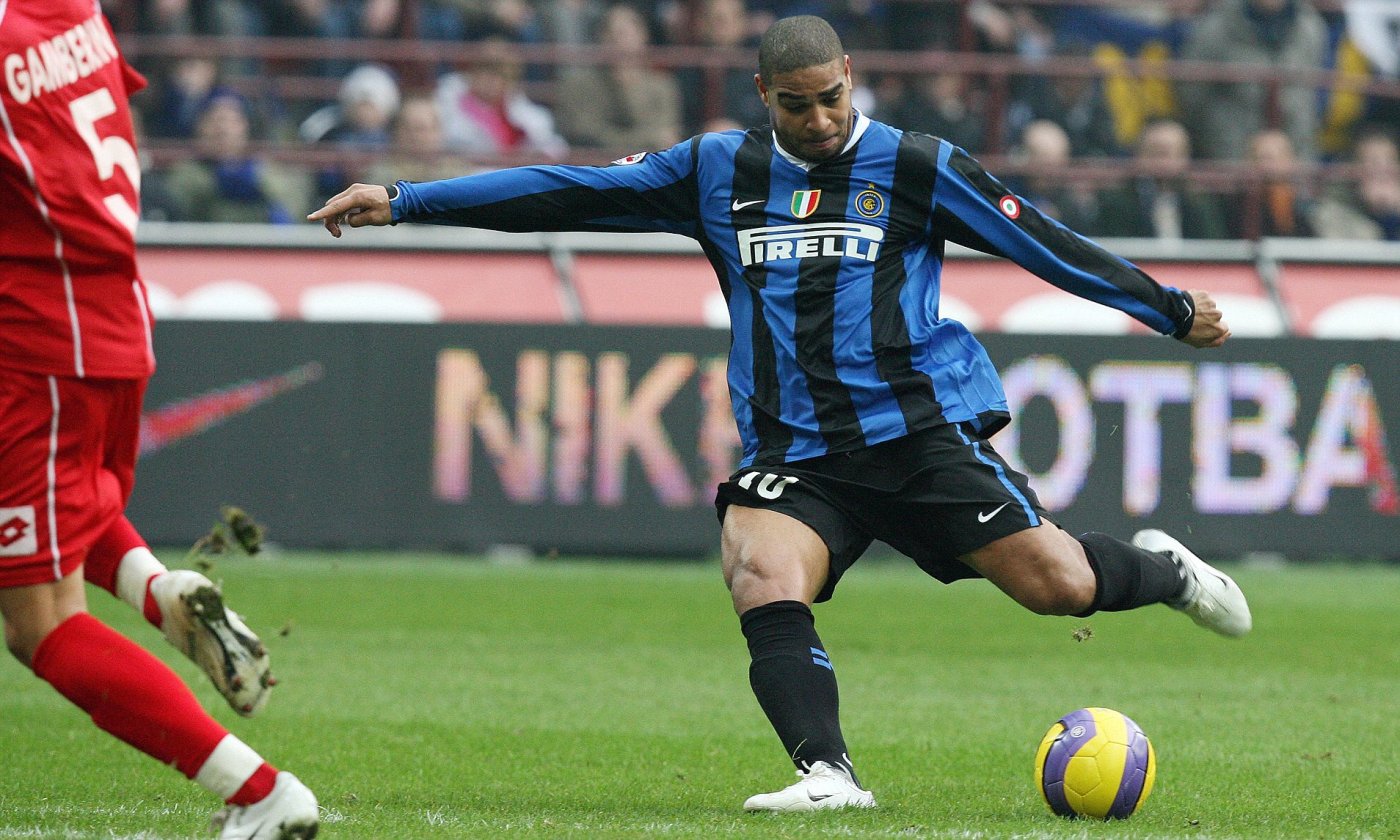
Adriano did not shoot a football so much as detonate it.
When the ball sat up on his left foot, defenders had half a second to decide whether to close him down, block the angle or simply brace themselves. At his best, he looked less like a centre-forward and more like a force moving through the pitch: broad-shouldered, explosive, technically Brazilian, physically imperial. The nickname made sense. L’Imperatore was not marketing. It was how he felt.
Yet Adriano’s story has never belonged only to power. The sadness is part of the memory too. The grief, the pressure, the homesickness, the struggle to carry a life that had changed too quickly. That is why he remains one of football’s most emotionally complex cult heroes: a striker who, for a few years, looked capable of conquering the game, while privately fighting battles the game could not solve.
Playing Style
Adriano was a centre-forward built from contradictions. He had the frame of a target man but the instincts of a street footballer. He could hold off centre-backs with his back to goal, roll them with one touch, then accelerate into space like a winger. His left foot was the headline — violent from distance, clean from tight angles, and trusted from free-kicks and penalties — but reducing him to shot power misses the refinement.
He carried the ball with long, aggressive strides. He could run the channels, attack crosses, combine in short passing moves and manufacture chances from situations that looked dead. A defender could do everything correctly — hold the line, show him wide, lean into contact — and still find himself watching Adriano shift the ball half a yard before smashing it past the goalkeeper.
In early-2000s Serie A, that mattered. Italy was still a school of elite defensive detail: compact blocks, cynical fouls, world-class centre-backs, tactical duels every weekend. Adriano did not merely survive that environment. He frightened it.
There was aggression in his football, but not cruelty. Off the pitch, his vulnerability became increasingly visible. The same player who could bully defenders looked painfully exposed when life demanded more than talent and fame could offer.
Rise to Fame
Adriano emerged from Flamengo, carrying the raw materials of a superstar: size, technique, speed and a left foot that sounded different. Inter moved early, bringing him to Italy in 2001, but his education came through loan spells that sharpened him.
At Fiorentina, there were flashes. At Parma, there was confirmation. In 37 appearances for Parma, Adriano scored 23 goals, forming a devastating partnership with Adrian Mutu and showing that his game was not just potential. It was production. He was young, but already looked too powerful for senior defenders.
His return to Inter felt like the arrival of a future Ballon d’Or contender. He had the aura of Ronaldo’s heir for Brazil, but with a heavier, more intimidating profile. Where Ronaldo glided and exploded, Adriano imposed and destroyed. Serie A had seen great strikers before, but few carried this mix of Brazilian imagination and heavyweight menace.
Peak Period: 2004–05
The peak came quickly and brutally.
Between Parma, Inter and Brazil, Adriano’s 2004–05 period remains the clearest snapshot of what he could be: decisive in Europe, dominant in Italy, and terrifying in international football. Inter officially credit him with 177 appearances and 74 goals across all competitions, but the numbers only explain part of the memory. The goals mattered because of how they arrived: free-kicks that swerved late, near-post rockets, defenders bounced aside, goalkeepers beaten before they had set their feet.
For Brazil, 2004 and 2005 turned promise into coronation. At the 2004 Copa América, Adriano was the tournament’s top scorer with seven goals and its most valuable player. His stoppage-time equaliser against Argentina in the final became one of his defining images: Brazil on the edge, Adriano finding one more act of violence and nerve.
A year later, he was again central as Brazil won the 2005 Confederations Cup. Adriano finished as top scorer with five goals and was recognised as the tournament’s best player. In the final, Brazil beat Argentina 4–1, with Adriano scoring twice. This was the Emperor at full scale: physically dominant, technically sharp, emotionally charged, and decisive when the stage demanded it.
Brazil and the Emperor Image
For a short period, Adriano looked like the natural heir to Brazil’s great centre-forward line. He won 48 caps and scored 27 goals for the Seleção, a record that reflects both his impact and the brevity of his true peak.
The Imperador nickname fitted because he did not play like a supporting act. He occupied space with authority. He carried the symbolic weight of Brazil’s No.9 tradition after Ronaldo: not identical in style, but similar in expectation. Supporters saw in him a striker who could lead the next era — powerful enough for Europe, skilful enough for Brazil, spectacular enough for the world.
That image still defines him. Adriano was not just effective. He was cinematic.
Inter Milan and the Cult Hero Paradox
At Inter, Adriano became a paradox: adored, feared, unforgettable, and ultimately unsustained. Supporters did not simply admire him for consistency. They loved him because his best moments felt permanent. The derby goals. The Champions League explosions. The Coppa Italia strikes. The solo run against Udinese. The sense that any loose ball within 30 yards of goal could become a headline.
But his story cannot be told honestly without care. The death of his father in 2004 was a profound turning point, and Adriano has spoken openly about how deeply it affected him. It would be simplistic to reduce everything to one event, but it would be dishonest to ignore it. Grief, pressure, isolation and expectation all shaped what followed.
Adriano himself later wrote: “My father’s death changed my life forever.” That sentence lands harder than any statistic. It reminds us that the footballer who looked indestructible was also a young man carrying pain.
Cult Legend Status
Adriano is a cult legend because he exists in football memory as both dominance and ache.
Great strikers are usually remembered through totals, medals and longevity. Adriano is remembered through sensation. The sound of the strike. The panic in defenders. The way Inter fans still speak about him as if describing weather: something that arrived, overwhelmed everything, then disappeared before anyone was ready.
His career was not empty. He won major honours with Inter, lifted the Copa América and Confederations Cup with Brazil, and later returned to Flamengo to help win the 2009 Brasileirão, finishing as joint top scorer with 19 league goals. But the emotional pull comes from the gap between what he achieved and what he seemed capable of sustaining.
Not a lazy “what if”, but a more human truth: football saw enough of Adriano to know greatness was real, and enough of his struggle to understand why greatness alone was not enough.
Decline and End of Career
After his Inter peak, Adriano’s career drifted. There was a loan to São Paulo, a moving return to Flamengo, a brief spell at Roma, time with Corinthians, another Flamengo return, and later Atlético Paranaense. There were flashes, especially in 2009, when he helped his boyhood club become Brazilian champions. That revival matters. It proves the quality never simply vanished.
But the rhythm was gone. Injuries, form, personal issues and the weight of expectation made permanence impossible. The end should not be treated as failure. It was the closing of a career that had asked too much of a man before he had found the tools to carry it.
Legacy
Adriano’s legacy is not clean, and that is why it endures. He was not the striker who gave football everything it expected. He was the striker who showed football something unforgettable, then reminded everyone that players are not machines built to satisfy our imagination.
At his best, Adriano made the game look terrifying. The ball on his left foot, the defender retreating, the goalkeeper frozen, the stadium inhaling before impact. But he also made football look deeply human: brilliant, wounded, powerful, fragile.
The Emperor remains a cult legend because he was more than a highlight reel. He was a feeling — the awe of watching a player who seemed unstoppable, and the empathy of knowing that nobody ever truly is.Key Statistics and Achievements
Key Statistics and Achievements
International Career
- Brazil: 48 caps, 27 goals
- Copa América winner: 2004
- Confederations Cup winner: 2005
- Won the Golden Boot and Golden Ball at the 2005 Confederations Cup
- Finished as top scorer at the 2004 Copa América
- Represented Brazil at the 2006 World Cup
- Became one of Brazil’s most feared forwards during the mid-2000s
Inter Milan
- 4 Serie A titles: 2005/06, 2006/07, 2007/08, 2008/09
- 2 Coppa Italia titles: 2004/05, 2005/06
- 3 Supercoppa Italiana titles: 2005, 2006, 2008
- Became a cult hero at Inter for his explosive power, left-footed shooting and ability to score from almost impossible positions
- At his peak, was viewed as one of the most physically dominant strikers in world football
Parma and Fiorentina Development Years
- Impressed at Parma, where his performances helped establish him as one of Serie A’s most exciting young forwards
- Built his reputation through a combination of pace, strength, technical quality and devastating shooting power
- Had an earlier loan spell at Fiorentina, gaining further Serie A experience before returning to Inter
Flamengo and Brazil Return
- Returned to Flamengo in 2009 and helped the club win the Campeonato Brasileiro Série A
- Finished as one of the league’s standout forwards during Flamengo’s title-winning season
- Reconnected emotionally with Brazilian football after a difficult period in Europe
- Also had later spells with Roma, Corinthians, Athletico Paranaense and Miami United
Individual Legacy
- Widely remembered as one of football’s great “what could have been” talents
- Celebrated for his left foot, power, balance, pace and almost frightening ball-striking
- His peak at Inter and Brazil remains one of the most devastating striker runs of the 2000s
- Became a deeply human football story, shaped by brilliance, grief, pressure and the difficulty of sustaining elite performance after personal loss
Sources / References
- Inter Milan official archive – Background on Adriano’s Inter career, major honours, goals, playing style and cult status among Nerazzurri supporters.
- CBF / Brazil national team records – Reference for Brazil caps, goals, Copa América involvement, Confederations Cup success and 2006 World Cup participation.
- FIFA archive – Supporting reference for Adriano’s 2005 Confederations Cup performances, Golden Boot, Golden Ball and wider international peak.
- Transfermarkt – Supporting reference for full career timeline, club spells, appearances, goals, positions and honours across Flamengo, Inter, Fiorentina, Parma, São Paulo, Roma, Corinthians, Athletico Paranaense and Brazil.
- Flamengo official archive / Brazilian league records – Context on Adriano’s 2009 return to Flamengo and his role in the club’s Campeonato Brasileiro Série A-winning season.


Leave a Reply