
Three Open Groups With No Margin for Complacency
Groups D, E and F contain three European heavyweights, two host or home-region teams and several dangerous middle-ranking nations.
Germany and the Netherlands are favourites in their respective sections, but neither has been handed an easy route. Group D may be the most open of the three, with the United States, Türkiye, Paraguay and Australia all capable of taking points from one another.
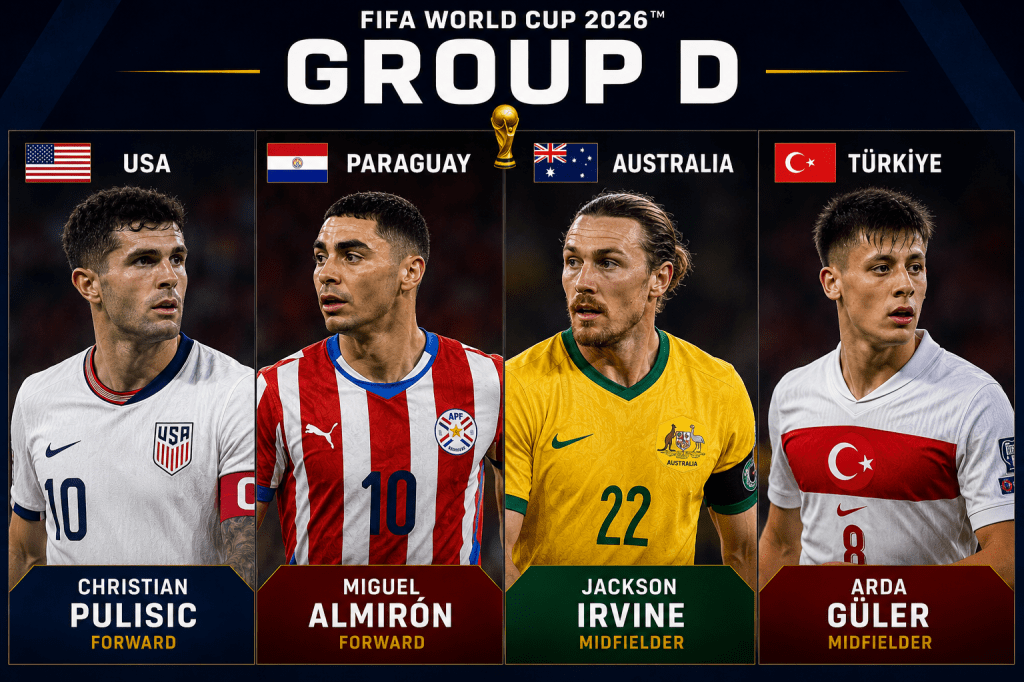
FIFA confirmed that the United States will face Paraguay, Australia and Türkiye.
United States — FIFA ranking: 16
The United States carry significant pressure as co-hosts.
Christian Pulisic is their decisive attacker, while Weston McKennie, Tyler Adams and Folarin Balogun form the core of a talented squad. Mauricio Pochettino wants a more aggressive pressing team, although consistency remains a problem.
Players to watch: Christian Pulisic, Weston McKennie, Folarin Balogun and Antonee Robinson.
Strengths: Athleticism, home support, pressing capacity and several players competing at elite clubs.
Weaknesses: Inconsistent chance creation, vulnerability after losing possession and uncertainty within the defensive line.
Paraguay — FIFA ranking: 40
Paraguay’s qualification was built on defensive improvement, intensity and a return to their traditional competitive identity.
Miguel Almirón drives transitions, Diego Gómez provides midfield energy and Julio Enciso offers creativity from distance or between the lines.
Players to watch: Miguel Almirón, Julio Enciso, Diego Gómez and Omar Alderete.
Strengths: Defensive aggression, duelling, counter-attacks and emotional resilience.
Weaknesses: Limited possession control and an attack that can struggle when opponents defend deeply.
Australia — FIFA ranking: 27
Australia once again arrive as an organised, physically committed tournament team.
Harry Souttar is a major set-piece target, Jackson Irvine provides leadership and Mat Ryan brings experience in goal. Their football may be direct, but their collective discipline makes them difficult to eliminate.
Players to watch: Harry Souttar, Jackson Irvine, Mat Ryan and Nestory Irankunda.
Strengths: Aerial power, team spirit, tournament experience and defensive commitment.
Weaknesses: Limited creativity, a transitional attack and a shortage of proven international goalscorers.
Türkiye — FIFA ranking: 22
Türkiye possess one of the tournament’s most exciting young attacking groups.
Arda Güler can dictate play from the right or centrally, Kenan Yıldız offers direct running and Hakan Çalhanoğlu controls midfield distribution.
Players to watch: Arda Güler, Kenan Yıldız, Hakan Çalhanoğlu and Orkun Kökçü.
Strengths: Technical quality, long-range shooting, creativity and youthful confidence.
Weaknesses: Defensive volatility, emotional inconsistency and a tendency to lose structure during open matches.
Group D prediction
- Türkiye
- USA
- Paraguay
- Australia
This is extremely difficult to call. Türkiye may have the highest attacking ceiling, while home advantage could carry the United States through.
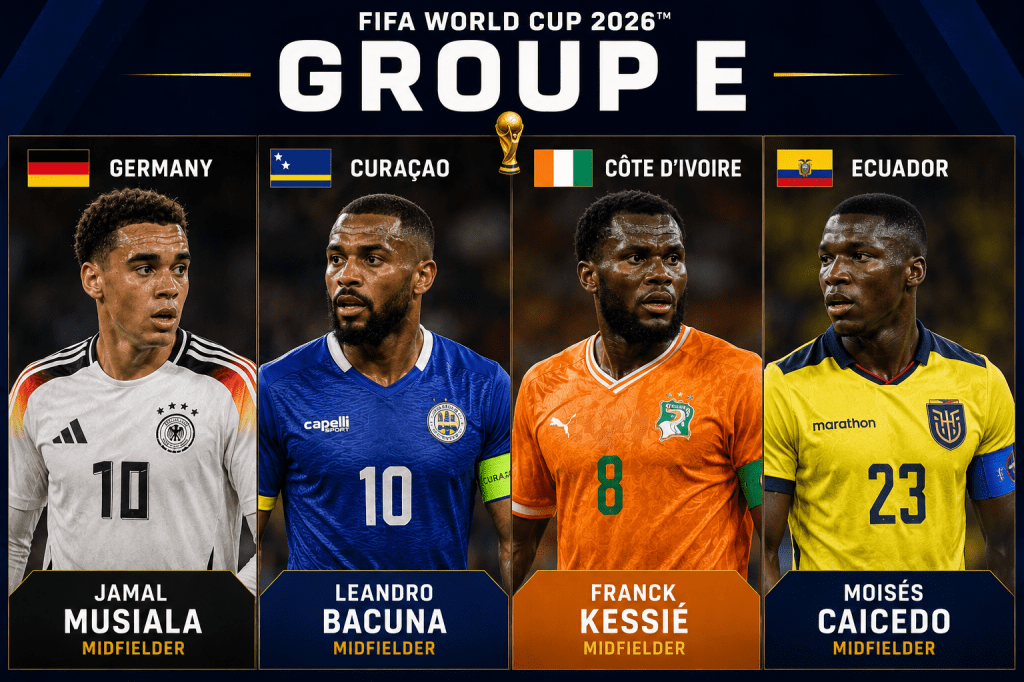
Germany face debutants Curaçao alongside Côte d’Ivoire and Ecuador.
Germany — FIFA ranking: 10
Germany possess a technically gifted generation led by Jamal Musiala and Florian Wirtz.
Joshua Kimmich provides leadership and distribution, while Antonio Rüdiger anchors the defence. Julian Nagelsmann is likely to use positional rotations and aggressive pressing.
Players to watch: Jamal Musiala, Florian Wirtz, Joshua Kimmich and Antonio Rüdiger.
Strengths: Creative midfielders, tactical flexibility, pressing and tournament heritage.
Weaknesses: Occasional defensive instability and uncertainty over the most effective centre-forward.
Curaçao — FIFA ranking: 82
Curaçao are the smallest country by population ever to qualify for the World Cup.
Their squad draws heavily from Dutch-developed players. Leandro Bacuna is the leader, while Eloy Room provides experience in goal. Curaçao completed qualification unbeaten and will not arrive simply to defend.
Players to watch: Leandro Bacuna, Eloy Room, Juninho Bacuna and Livano Comenencia.
Strengths: Technical education, team unity, tactical familiarity and freedom from pressure.
Weaknesses: Limited depth, defensive vulnerability against elite pace and little experience against top-level national teams.
Côte d’Ivoire — FIFA ranking: 34
Côte d’Ivoire combine athleticism with significant individual talent.
Ousmane Diomande strengthens the defence, Franck Kessié provides power in midfield and Simon Adingra offers speed from wide areas.
Players to watch: Franck Kessié, Ousmane Diomande, Simon Adingra and Amad Diallo.
Strengths: Physical power, wide attacking, midfield ball-winning and one-on-one quality.
Weaknesses: Inconsistent control, defensive lapses and occasional overdependence on individual actions.
Ecuador — FIFA ranking: 23
Ecuador may be the group’s strongest challenger to Germany.
Moisés Caicedo leads an athletic midfield, Willian Pacho provides defensive composure and Kendry Páez offers creativity. Ecuador are comfortable pressing high or defending compactly.
Players to watch: Moisés Caicedo, Willian Pacho, Piero Hincapié and Kendry Páez.
Strengths: Athleticism, defensive pace, midfield intensity and an excellent emerging generation.
Weaknesses: Inconsistent finishing and limited experience managing the decisive moments of knockout football.
Group E prediction
- Germany
- Ecuador
- Côte d’Ivoire
- Curaçao
Germany should lead the group, but Ecuador are capable of pushing them closely. Côte d’Ivoire remain a credible third-place qualifier.
Group F: Netherlands, Japan, Sweden and Tunisia
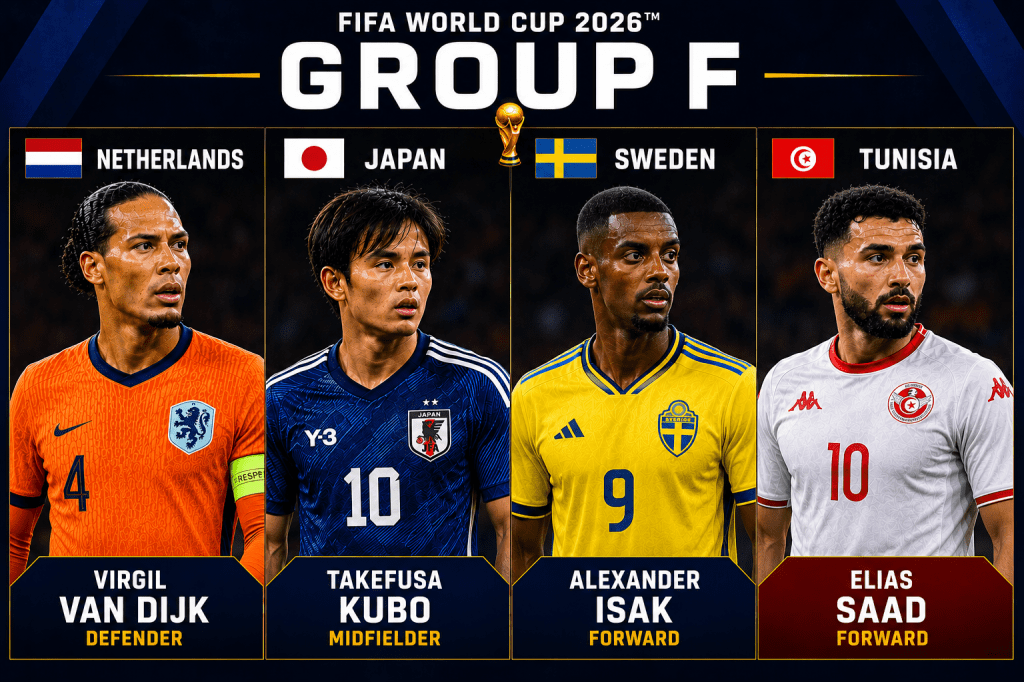
The Netherlands face a difficult section containing Japan, Sweden and Tunisia.
Netherlands — FIFA ranking: 7
The Netherlands have quality across every line.
Virgil van Dijk leads the defence, Frenkie de Jong controls midfield and Xavi Simons offers creativity. Cody Gakpo and Jeremie Frimpong provide direct attacking options.
Players to watch: Virgil van Dijk, Frenkie de Jong, Xavi Simons and Cody Gakpo.
Strengths: Defensive leadership, technical midfielders, tactical flexibility and strong wide options.
Weaknesses: Inconsistent finishing and a tendency to lose control against teams that press their midfield aggressively.
Japan — FIFA ranking: 18
Japan are among the tournament’s most tactically sophisticated outsiders.
Takefusa Kubo, Kaoru Mitoma and Ritsu Dōan give them technical quality in wide areas, while Wataru Endo provides balance.
Players to watch: Takefusa Kubo, Kaoru Mitoma, Wataru Endo and Ayase Ueda.
Strengths: Pressing, technical combinations, speed and positional discipline.
Weaknesses: Physical vulnerability at set pieces and occasional difficulty converting possession into goals.
Sweden — FIFA ranking: 38
Sweden possess considerable attacking potential despite the reported loss of Dejan Kulusevski through injury.
Alexander Isak and Viktor Gyökeres give them two elite forwards, while Hugo Larsson adds energy in midfield.
Players to watch: Alexander Isak, Viktor Gyökeres, Hugo Larsson and Lucas Bergvall.
Strengths: Centre-forward quality, physicality and direct attacking.
Weaknesses: Defensive transitions, creativity without Kulusevski and questions about fitting two leading strikers into a balanced system.
Tunisia — FIFA ranking: 44
Tunisia are habitually disciplined and difficult to break down.
Ellyes Skhiri protects midfield, Hannibal Mejbri provides aggression and Ali Abdi offers energy from the left.
Players to watch: Ellyes Skhiri, Hannibal Mejbri, Ali Abdi and Aïssa Laïdouni.
Strengths: Compact defending, midfield work rate and tournament experience.
Weaknesses: Limited goal production and difficulty recovering after conceding first.
Group F prediction
- Netherlands
- Japan
- Sweden
- Tunisia
Japan’s collective organisation could carry them above Sweden, although Isak and Gyökeres make the Swedes extremely dangerous.


Leave a Reply