
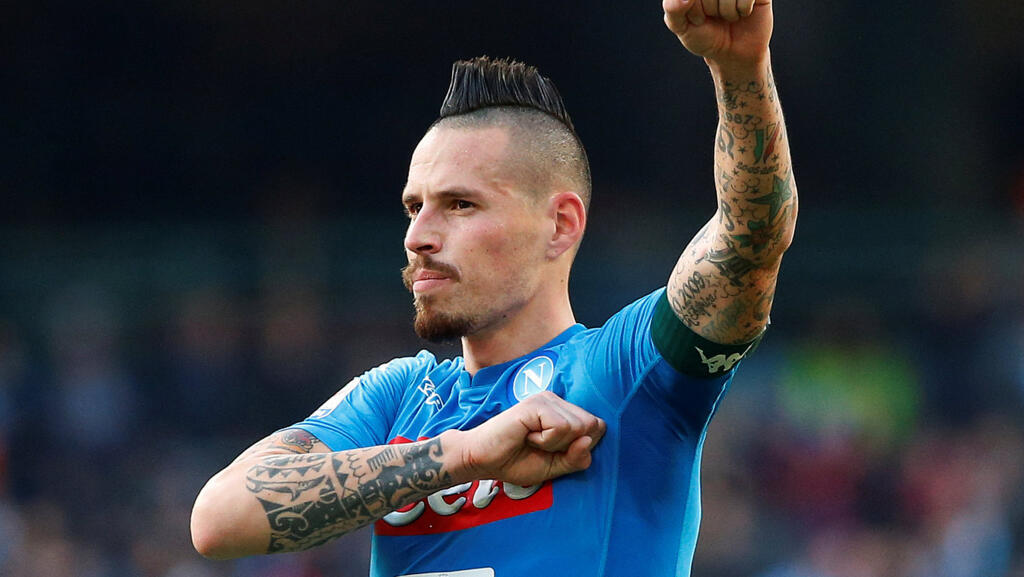
Marek Hamšík looked like a player drawn from Naples itself: sharp lines, high drama, impossible to ignore. The mohawk made him instantly recognisable, but the football gave him permanence. In the blue of Napoli, with San Paolo roaring around him, he became the elegant runner arriving late into the box, the captain stitching midfield to attack, the quiet authority in a team often defined by noise, speed and emotion.
He was not Napoli’s most explosive attacker, nor its most mythic figure. That space will always belong elsewhere. Hamšík’s greatness was different. He stayed. He grew with the club. He helped carry Napoli from post-bankruptcy recovery to Champions League respectability, from hopeful returnees to genuine Scudetto challengers. In a city that remembers football through feeling, he became part of the modern identity.
Playing Style
Hamšík was a midfielder of timing. His best work often began away from the spotlight: drifting between lines, opening angles, accelerating into space just as the defence turned its head. As an attacking midfielder and advanced No. 8, he had the rare ability to look understated while constantly influencing the rhythm of a match.
Technically, he was clean rather than theatrical. His passing range allowed Napoli to move quickly through midfield, while his first-time finishing made him a constant threat from cut-backs and loose clearances. He could combine in tight spaces, carry the ball forward, switch play, press intelligently and arrive in the penalty area with the instinct of a second striker.
Under Walter Mazzarri, he thrived in a direct, transition-heavy Napoli built around vertical running and devastating attacking breaks. Under Rafa Benítez, he adapted to a more structured attacking midfield role. Under Maurizio Sarri, he became the left-sided No. 8 in one of Europe’s most fluid possession teams, linking Jorginho, Lorenzo Insigne and Dries Mertens with intelligence and restraint. Later, Carlo Ancelotti even saw him as a deeper playmaker.
Hamšík was rarely the loudest superstar on the pitch. He was the player who made the team function.
Rise to Fame
Born in Banská Bystrica, Hamšík came through Slovan Bratislava before moving to Brescia as a teenager. Italy became his football education. Brescia gave him the platform, but Napoli gave him the stage.
His move in 2007 came at a symbolic moment. Napoli had just returned to Serie A after bankruptcy, lower-league punishment and years of reconstruction. The club needed more than signings; it needed pillars. Hamšík, still only 20, became one almost immediately.
He arrived before the Champions League nights, before the title races, before the modern Napoli machine had fully formed. Alongside players such as Ezequiel Lavezzi and later Edinson Cavani, he helped change the emotional temperature around the club. Napoli were no longer just recovering. They were rising.
Peak Period: The Midfield Constant
Hamšík’s peak stretched across eras, but the period from 2010 to 2018 captures him at his most complete. Napoli changed managers, systems and attacking focal points, yet Hamšík remained central. He played with Lavezzi’s chaos, Cavani’s ferocity, Gonzalo Higuaín’s penalty-box dominance, Insigne’s local artistry and Mertens’ reinvention as a false nine. Through all of it, he adapted.
The numbers support the memory. Hamšík finished his Napoli career with 520 appearances and 121 goals in all competitions, extraordinary production for a midfielder. In Serie A alone, he reached 408 league appearances and 100 league goals for the club. Those were not empty statistics; they were spread across the seasons in which Napoli became a European fixture again.
He was there for the Coppa Italia wins in 2011/12 and 2013/14, the Supercoppa Italiana triumph in 2014, the return to the Champions League, and the Sarri years when Napoli played some of the most admired football in Europe. The 2017/18 side did not win the Scudetto, but it reached 91 points and pushed Juventus harder than almost anyone had managed in that era. Hamšík was no longer the young arrival by then. He was the captain, the reference point, the face of continuity.
Napoli Icon and Club Legacy
Hamšík’s Napoli legacy is inseparable from loyalty. In an era when elite football often turns players into assets and clubs into stepping stones, he stayed through the hard work of building something. Bigger and richer clubs circled, but Naples became his football home.
He captained the side, became Napoli’s all-time appearance leader, and for a period stood as the club’s all-time top scorer after surpassing Diego Maradona’s record. That achievement carried obvious symbolic weight, but it should not be misunderstood. Hamšík did not replace Maradona in the Neapolitan imagination. Nobody does. Maradona was miracle and mythology. Hamšík was service, consistency and modern rebirth.
Even Maradona recognised the moment. After Hamšík moved level with his Napoli goal record, Maradona wrote: “My congratulations go to Marek Hamsik.” It was a small line, but a meaningful passing of statistical history from one Napoli era to another.
Slovakia and International Career
For Slovakia, Hamšík was not just a star; he was the reference point for a football nation. He retired from international football as Slovakia’s record appearance holder and record goalscorer, with 138 caps and 26 goals.
He was part of Slovakia’s historic 2010 World Cup campaign, when they reached the last 16 and defeated Italy in one of the tournament’s great shocks. At Euro 2016, he was central again, scoring a superb goal against Russia and helping Slovakia reach the knockout stage in their first European Championship as an independent nation. He later remained involved through Euro 2020, stretching his influence across generations.
For Slovakia, Hamšík’s importance was not only creative. He gave the team identity, leadership and belief. He was the player opponents knew they had to stop, and the player teammates trusted to carry the ball, calm the game or produce the decisive pass.
Cult Legend Status
Hamšík is a cult legend because his story has layers. The mohawk made him memorable, but the football made him beloved. He had style without vanity, leadership without theatre, and consistency without dullness. He was technical, intelligent, durable, selfless and productive.
He belongs in this series because he was more than a very good midfielder. He became a symbol of Napoli’s return. Supporters watched him grow from a young signing into captain, record-breaker and emotional anchor. He gave them years, not moments. In modern football, that matters.
End of Career
Hamšík left Napoli in 2019 for Dalian Professional in China, closing the defining chapter of his career. Later spells with IFK Göteborg and Trabzonspor showed the same professionalism in different surroundings. At Trabzonspor, he helped the club win the 2021/22 Süper Lig title, a historic triumph that ended a long wait and added a league championship to his honours list.
His final years were not about decline so much as distance from the place that had defined him. Away from Naples, he remained respected. In Naples, he remained theirs.
Legacy
Marek Hamšík’s legacy is not only measured in appearances, goals or records, even though he has plenty of each. It lives in the arc of Napoli’s modern story. He arrived when the club was rebuilding and left after helping restore its European weight. He wore the armband without needing to perform leadership as theatre. He made late runs, scored important goals, connected brilliant attackers and gave Napoli supporters a captain they could believe in.
In football history, Hamšík stands as one of Slovakia’s greatest ever players and one of Napoli’s defining modern figures. In the Cult Legends canon, he is something even more specific: the mohawk in blue, the midfielder of timing and loyalty, the captain who helped a city remember what it was becoming.
Key Statistics and Achievements
International Career
- Slovakia: 138 caps, 26 goals
- Slovakia’s most-capped player
- Slovakia’s all-time leading goalscorer
- Represented Slovakia at the 2010 World Cup, Euro 2016 and Euro 2020
- Captained Slovakia through one of the strongest periods in the country’s football history
- Key figure in Slovakia reaching the last 16 at the 2010 World Cup and Euro 2016
Napoli
- 520 appearances, 121 goals
- Coppa Italia winner: 2011/12, 2013/14
- Supercoppa Italiana winner: 2014
- Became Napoli’s all-time appearance leader
- Formerly held Napoli’s all-time goalscoring record before being overtaken by Dries Mertens
- Served as Napoli captain and became one of the defining players of the club’s modern era
- Helped restore Napoli from a rebuilding post-Maradona club into a consistent Champions League-level side
Brescia and Early Career
- Moved to Italy as a teenager with Brescia
- Developed in Serie B before earning his move to Napoli in 2007
- Quickly became recognised as one of the most complete young midfielders in Italian football
- His Brescia spell laid the foundation for his tactical discipline, ball-carrying and goal threat from midfield
Later Club Career
- Played for Dalian Professional in China after leaving Napoli in 2019
- Returned to European football with IFK Göteborg in Sweden
- Finished his club career with Trabzonspor in Turkey
- Süper Lig winner with Trabzonspor in 2021/22, helping the club claim its first Turkish league title in 38 years
Individual Legacy
- Widely regarded as Slovakia’s greatest ever footballer
- Remembered as one of Serie A’s most consistent attacking midfielders of the 2010s
- Celebrated for his stamina, timing of runs, long-range shooting, leadership and ability to contribute goals from midfield
- Became a Napoli cult hero for his loyalty, longevity and role in the club’s rise before its eventual Scudetto breakthrough
Sources / References
- Napoli official archive – Background on Hamšík’s Napoli career, total appearances, goals, captaincy, club honours and status as one of the defining players of the modern era.
- Slovak Football Association records – Reference for Slovakia caps, goals, captaincy, all-time appearance record and national team legacy.
- UEFA archives – Supporting context on Hamšík’s role at Euro 2016 and Euro 2020, plus Slovakia’s tournament performances.
- FIFA World Cup archive – Reference for Hamšík’s involvement at the 2010 World Cup and Slovakia’s run to the last 16.
- Transfermarkt – Supporting reference for full career timeline, club spells, positions, appearances, goals and honours across Brescia, Napoli, Dalian Professional, IFK Göteborg, Trabzonspor and Slovakia.


Leave a Reply